
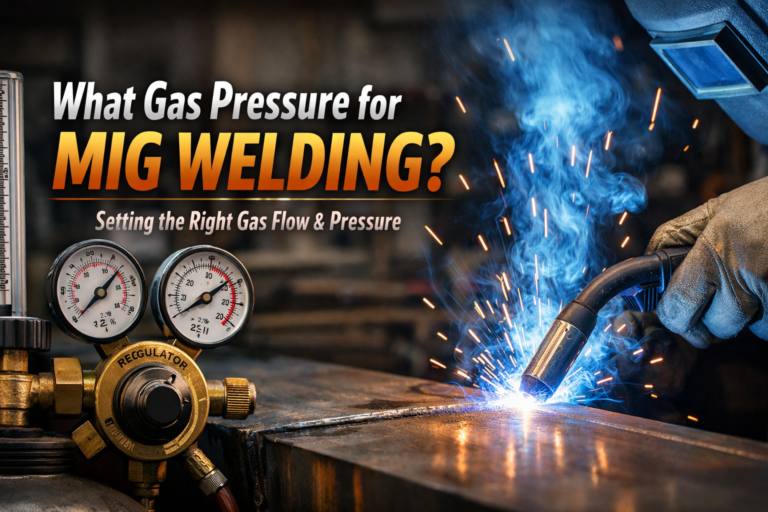
Gas pressure plays a big role in MIG welding, but many beginners overlook its importance. If your gas pressure is wrong, your welds can be weak, dirty, or full of holes. Getting this setting right is not hard, but you must understand the basics, know what affects pressure, and learn how to adjust it for different jobs.
This guide explains everything you need to know about gas pressure for MIG welding, so you can make strong, clean welds every time.
Why Gas Pressure Matters In Mig Welding
The right gas pressure protects the weld from air. Shielding gas keeps oxygen and nitrogen away, so your weld does not rust or get holes. If your pressure is too low, air sneaks in and ruins the weld. Too high, and you waste gas or even cause turbulence, which also lets air mix in.
Many new welders think more gas is always better. In reality, too much gas can cause problems. You need just enough to cover the weld, but not so much that it blows away.
Common Shielding Gases And Recommended Pressure
Most MIG welding uses argon, CO2, or a mix of both. Each gas behaves differently, so you must set pressure based on the type.
| Gas Type | Typical Pressure (psi) | Flow Rate (CFH) | Notes |
|---|---|---|---|
| 100% Argon | 25-30 | 20-25 | Best for aluminum |
| 100% CO2 | 20-25 | 20-30 | Good for steel |
| Argon/CO2 Mix | 25-30 | 20-25 | Common for mild steel |
CFH means cubic feet per hour. Most welders set the regulator to show flow rate (CFH), not pressure (psi). But knowing both helps you adjust for different jobs.
Factors That Affect Gas Pressure Settings
Choosing the right gas pressure depends on several things. If you ignore these, your welds may suffer.
1. Welding Environment
If you weld outside or where wind is strong, you need more gas. Wind blows shielding gas away, so increase the flow rate to 30-35 CFH. Indoors, stick to the normal range.
2. Nozzle Size And Shape
A wider nozzle needs more gas, because it covers a bigger area. Small nozzles can use less. Check your torch specs for guidance.
3. Type Of Metal
Aluminum needs more argon and steady gas coverage. Steel can use CO2 or mixed gas. Adjust pressure based on metal thickness and type.
4. Wire Speed And Voltage
Fast wire speed or high voltage means more heat, which can use more gas. If your weld puddle is large, increase flow slightly.
5. Gas Leaks Or Blockages
If hoses, fittings, or the nozzle leak, you lose pressure. Always check for leaks and clean your nozzle often.
How To Set Gas Pressure Correctly
Setting gas pressure is easy if you follow these steps:
1. Start With Manufacturer’s Recommendation
Look at your MIG welder’s manual. Most say 20-25 CFH for basic jobs.
2. Check The Regulator And Flowmeter
Open the tank slowly. Adjust the regulator until the flowmeter shows the desired rate. For most jobs, 25 CFH is ideal.
3. Test On Scrap Metal
Make a test weld. Watch the weld bead—if it’s rough, smoky, or has holes, increase the gas. If you see too much gas blowing, lower the flow.
4. Adjust For Wind Or Drafts
If you feel a breeze, set the flow to 30-35 CFH. If welding inside, keep it at 20-25 CFH.
5. Monitor Gas Usage
If your tank empties quickly, you may be using too much gas. Reduce flow and check for leaks.
Examples Of Gas Pressure Settings
To make this clearer, see how gas pressure changes for different jobs:
| Job Type | Gas | Flow Rate (CFH) | Notes |
|---|---|---|---|
| Indoor mild steel | Argon/CO2 Mix | 20-25 | Standard pressure |
| Outdoor aluminum | 100% Argon | 30-35 | Increase flow for wind |
| Thick steel, high amperage | CO2 | 25-30 | More gas needed |
Common Mistakes And How To Avoid Them
Many beginners make mistakes with gas pressure. Here are a few and how to fix them:
1. Setting The Pressure Too High
This wastes gas and can cause turbulence. Use only as much as needed.
2. Ignoring Leaks
Leaks cut gas coverage. Check hoses, fittings, and nozzles often.
3. Using Wrong Gas For The Metal
Always match gas to metal type—argon for aluminum, CO2 or mix for steel.
4. Not Adjusting For Environment
If you weld outside, increase flow rate. Indoors, use normal settings.
A non-obvious tip: Sometimes, welders confuse CFH and psi. Always check your regulator—most show CFH, which is what matters for coverage.
Another insight: If you hear a loud hissing from the nozzle, your flow is probably too high. Lower it until the sound is gentle.
Gas Pressure Vs. Gas Flow—what’s The Difference?
Many people mix up gas pressure and gas flow. Gas pressure is measured in psi, and gas flow in CFH. For MIG welding, you care about flow rate—how much gas covers the weld each hour.
You set flow using the regulator and flowmeter, not just pressure. Most welders use 20-25 CFH, which is enough to shield the weld without wasting gas.
| Measurement | Unit | Importance |
|---|---|---|
| Pressure | psi | Tank storage |
| Flow | CFH | Weld coverage |
Practical Tips For Better Results
- Use a flowmeter for accurate settings, not just the regulator.
- Always check for leaks before welding.
- If you change nozzles, recheck your flow rate.
- Store your gas tanks upright, away from heat.
- Clean your nozzle often to prevent blockages.
For more technical details and best practices, you can visit Lincoln Electric.
Getting gas pressure right is one of the easiest ways to improve your welds. It saves money, reduces defects, and makes your work look professional.
Frequently Asked Questions
What Happens If My Gas Pressure Is Too Low?
If your gas pressure is too low, air mixes with the weld, causing porosity (tiny holes), weak welds, and spatter. Always keep flow above 20 CFH.
Can I Use The Same Gas Pressure For All Metals?
No. Aluminum needs more argon and higher flow (25-30 CFH), while steel can use CO2 or mix at standard flow (20-25 CFH).
How Do I Know If My Gas Pressure Is Correct?
Check the weld bead. If it’s shiny, smooth, and has no holes, your pressure is good. Test on scrap metal before starting your real project.
Is Gas Pressure The Same As Flow Rate?
No. Gas pressure is the force in the tank (psi). Flow rate is how much gas covers the weld (CFH). Adjust flow rate for welding.
Do I Need To Change Gas Pressure If Welding Outside?
Yes. Wind blows shielding gas away. Increase your flow rate to 30-35 CFH for outdoor welding to keep the weld protected.
Getting your gas pressure right is simple but makes a big difference. With these tips, you’ll weld stronger, cleaner, and more confidently.