
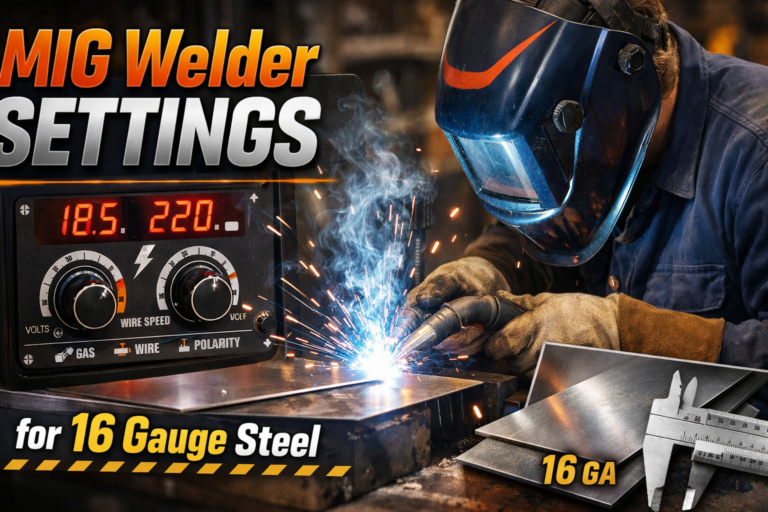
When working with 16 gauge steel, getting your MIG welder settings right is essential. This steel thickness is common in automotive, home repair, and fabrication projects. Poor settings can lead to weak welds, burn-through, or excessive spatter. With the right adjustments, you can achieve clean and strong welds—even if you’re new to welding. Below, you’ll find detailed guidance for each key MIG welder setting you need to consider for 16 gauge steel.
1. Wire Diameter
For 16 gauge steel, the most common wire sizes are 0.023 inch and 0.030 inch. The thinner wire (0.023″) is easier to control and reduces heat input, which helps prevent burn-through. If you need more filler or are welding thicker joints, use 0.030″.
2. Wire Feed Speed
Wire feed speed controls how fast the wire enters the weld pool. For 16 gauge steel, start with 90–140 inches per minute for 0.023″ wire, and 140–200 inches per minute for 0.030″ wire. Adjust up or down if you hear popping or the wire burns back.
3. Voltage Setting
Correct voltage ensures good penetration without burning through. For 16 gauge steel, set your MIG welder to 16–18 volts. Lower voltage may cause poor fusion; higher voltage can create holes. Always check your welder’s manual for specific recommendations.
4. Shielding Gas
Most welders use 75% argon / 25% CO2 for mild steel. This mix gives smooth welds with less spatter. Pure CO2 is cheaper but creates more spatter and rougher welds. For 16 gauge steel, the 75/25 mix is ideal.
5. Gas Flow Rate
Set your gas flow rate to 20–25 cubic feet per hour (CFH). Too low causes porosity; too high wastes gas and may create turbulence. Use higher flow in drafty conditions.
6. Polarity
MIG welding 16 gauge steel needs DC electrode positive (DCEP). This polarity improves penetration and weld quality. Double-check your machine’s polarity before starting.
7. Travel Speed
Move the torch at a steady pace—about 10–14 inches per minute. Too slow causes excess heat and burn-through; too fast creates weak welds and lack of fusion. Practice to find your rhythm.
8. Torch Angle
Keep the torch at a 10–15° push angle. This means the nozzle points slightly in the direction you’re moving. Avoid steep angles, which can cause spatter and uneven welds.
9. Stickout
Stickout is the length of wire from the nozzle to the workpiece. For 16 gauge steel, use a 3/8″ to 1/2″ stickout. Short stickout increases heat; long stickout reduces penetration.
10. Cleanliness
Always clean the steel before welding. Remove rust, oil, paint, and dirt using a wire brush or grinder. Dirty metal leads to weak welds and porosity.
11. Joint Type
Popular joints for 16 gauge are lap, butt, and T-joints. Butt joints need careful heat control to avoid burn-through. Lap and T-joints are more forgiving.
12. Technique
Use a steady, small weave or straight-line technique. Avoid large weaving motions, which can overheat thin steel. Short welds (1–2 inches) help control heat.
13. Duty Cycle
Check your welder’s duty cycle before welding. For 16 gauge steel, most home MIG welders can run at medium power without overheating. If you’re welding long seams, let the machine cool as needed.
14. Amperage
For 16 gauge steel, set your welder to 60–90 amps. Too high amps cause burn-through; too low creates poor fusion. Adjust based on wire size and joint type.
15. Spatter Control
To reduce spatter:
- Use the right shielding gas.
- Adjust voltage and wire speed for a smooth arc.
- Keep the torch angle consistent.
Spatter can be minimized with proper prep and settings.
16. Weld Appearance
A good weld on 16 gauge steel should be smooth, consistent, and slightly convex. Avoid excessive reinforcement or undercut. Small ripples in the bead show proper travel speed.
Here’s a quick comparison of recommended settings for the two most common wire sizes:
| Setting | 0.023″ Wire | 0.030″ Wire |
|---|---|---|
| Wire Feed Speed | 90–140 IPM | 140–200 IPM |
| Voltage | 16–17 V | 17–18 V |
| Amperage | 60–75 A | 75–90 A |
Practical Tips For Beginners
Many new welders overlook two key points: pre-heating and test welds. While pre-heating isn’t essential for 16 gauge, a short test weld on scrap metal helps you fine-tune settings. Also, beginners often forget to check nozzle cleanliness. A dirty nozzle can block gas flow and ruin your weld.
Another useful tip: Watch the weld bead and listen to the arc. A smooth, steady “sizzling bacon” sound means the settings are right. If you hear popping or see erratic beads, adjust voltage or wire speed.
Mistakes To Avoid
- Using too much heat: This can burn holes in 16 gauge steel.
- Skipping cleaning: Even light rust or oil can cause defects.
- Wrong polarity: Always use DCEP for MIG on steel.
- Too long stickout: Reduces penetration and control.
- Ignoring joint preparation: Fit-up affects weld quality.
Common Applications
16 gauge steel is often used in automotive panels, HVAC ductwork, furniture frames, and light structural repairs. Good MIG settings make these jobs easier and produce stronger results.
Here’s a quick comparison of joint suitability for 16 gauge steel:
| Joint Type | Ease of Welding | Strength |
|---|---|---|
| Lap Joint | Easy | High |
| Butt Joint | Moderate | Medium |
| T-Joint | Easy | High |
Weld Quality Checklist
- Consistent bead shape
- No undercut or excessive convexity
- Minimal spatter
- Good penetration
- Smooth surface
If you follow these guidelines, your welds on 16 gauge steel will be strong and neat. For more info about welding standards, check Wikipedia.
Frequently Asked Questions
What Is The Best Wire Size For 16 Gauge Steel?
0.023″ wire is ideal for thin steel, but 0.030″ can be used for larger joints.
Should I Use Pure Co2 Or A Mix For Shielding Gas?
A 75% argon / 25% CO2 mix is best. Pure CO2 is cheaper but causes more spatter.
How Can I Avoid Burn-through?
Keep voltage and amperage low, move the torch steadily, and use short welds.
What Torch Angle Should I Use?
A 10–15° push angle helps control weld shape and reduces spatter.
Can I Weld 16 Gauge Steel With A Flux Core Wire?
Yes, but you’ll get more spatter and rougher welds. Use gas-shielded MIG for best results.
Careful preparation and the right settings will give you clean, strong welds on 16 gauge steel. Practice on scrap metal before your main project, and adjust as needed for perfect results.