
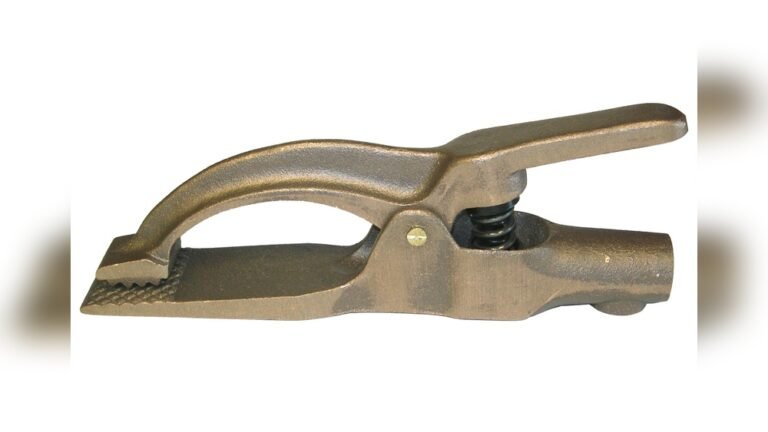
A ground clamp, often called a weld ground or earth clamp, is a vital piece of equipment in the welding process. It establishes a secure electrical connection between the welding machine and the workpiece, allowing the electrical current to flow correctly. Without a proper ground clamp, welding would be impossible, as the arc needed to melt metal could not be sustained. This connection ensures the circuit is complete, directing the current from the power source, through the electrode, to the workpiece, and back to the power source.
The quality and type of ground clamp used can significantly impact welding performance, safety, and the final weld quality. Understanding its function, different types, and best practices for use is essential for any welder, from hobbyists to seasoned professionals. This article will explore what a ground clamp is, why it’s so important, the different types available, and how to use them effectively.
The Crucial Role Of The Ground Clamp In Welding
The fundamental purpose of a ground clamp is to provide a safe and efficient path for electricity. In welding, particularly with processes like stick welding (SMAW) and MIG welding (GMAW), the workpiece is connected to the negative terminal of the welding power source (in DCEN, Direct Current Electrode Negative, or DC polarity). This creates a closed electrical circuit.
When the welding electrode is brought close to the workpiece, the electrical resistance between them creates a gap. The power source then forces a large amount of electrical current across this gap, generating intense heat. This heat melts the electrode and the base metal, forming the weld.
The ground clamp is the component that completes this circuit by firmly attaching to the workpiece and carrying the current back to the welding machine.
A poor or loose connection can lead to several problems:
- Arc Instability: The electrical current may fluctuate, causing an inconsistent and difficult-to-control arc. This can result in spatter, porosity, and weak welds.
- Increased Heat: If the connection has high resistance, the clamp itself can overheat, posing a fire hazard and potentially damaging the clamp or workpiece.
- Reduced Welding Speed: An unstable arc makes it harder to weld efficiently, slowing down the process.
- Safety Hazards: A loose ground can lead to electrical shock, especially if the welder is in contact with other conductive materials.
Therefore, a good ground connection is not just about making the weld happen; it’s about making it happen safely, efficiently, and with high quality.
Types Of Ground Clamps
Ground clamps come in various designs, each suited for different applications and welding environments. The primary goal for all types is to provide a secure, low-resistance connection.
Magnetic Ground Clamps
Magnetic ground clamps use powerful magnets to attach to ferrous (iron or steel) workpieces. They offer a quick and easy way to establish a ground connection, especially on large or irregularly shaped metal parts.
- Pros: Fast to attach and remove, can be very strong on clean, flat metal surfaces. Some models have a switch to turn the magnetism on/off, making them easier to position.
- Cons: Only work on ferrous metals. The magnet’s holding power can be reduced by paint, rust, or uneven surfaces. Can be difficult to get a good connection on thin materials or rounded edges.
C-clamps (g-clamps)
These are standard workshop clamps that can be used as ground clamps. They provide a strong mechanical grip on the workpiece.
- Pros: Versatile, can grip a wide range of shapes and sizes. Provide a very secure mechanical connection.
- Cons: Can be slower to attach and remove than other types. The clamp itself needs to be conductive, and the contact point with the workpiece must be clean and free of paint or rust for good conductivity. Can sometimes be bulky and get in the way.
Battery Terminal Clamps (alligator Clamps)
Resembling large alligator clips, these clamps offer a strong bite and are often used for temporary connections or on smaller projects.
- Pros: Easy to attach and detach, provide a good grip. Can be used on a variety of materials and shapes.
- Cons: The spring mechanism can weaken over time, reducing grip strength. They may not provide as low a resistance connection as some other types due to potentially smaller contact areas.
Lincoln Style (spring-loaded) Clamps
These are perhaps the most common type of ground clamp found in professional welding shops. They feature a strong spring mechanism that forces two conductive jaws together, ensuring a tight grip and good electrical contact.
- Pros: Excellent conductivity due to large contact surfaces and strong spring pressure. Durable and reliable. Suitable for a wide range of applications.
- Cons: Can be heavier than other types. Requires a clean surface for optimal performance.
Rotary Ground Clamps
These are a more advanced type designed for specific applications, such as welding on rotating parts or when the workpiece is difficult to access. They use a rotating mechanism to maintain contact as the workpiece moves, ensuring a continuous ground.
- Pros: Maintain consistent contact on moving or rotating workpieces. Ideal for automated welding or large-scale fabrication.
- Cons: More expensive and complex than standard clamps. Require specific setup and maintenance.

Credit: www.lincolnelectric.com
Key Factors For Choosing A Ground Clamp
When selecting a ground clamp, several factors should be considered to ensure optimal performance and safety.
Amperage Rating
Ground clamps are rated for the maximum amperage they can safely handle. It’s crucial to match the clamp’s rating to the welding machine’s output. Using a clamp with too low an amperage rating can cause it to overheat and fail, creating a safety hazard and interrupting the weld.
For example, a clamp rated for 200 amps might be sufficient for light-duty hobbyist welding, while heavy industrial applications might require clamps rated for 400 amps or more.
Material And Construction
The clamp should be made of a durable, conductive material like copper or brass. These metals offer good electrical conductivity and resist corrosion. The jaws should be robust, and the spring mechanism (if applicable) should be strong enough to maintain a secure grip.
Ease Of Use And Connection
Consider how easy the clamp is to attach and detach. For frequent repositioning or working on large structures, a quick-attach clamp like a magnetic or Lincoln-style might be preferable. The ability to get a clean, solid connection is paramount.
Type Of Workpiece
As mentioned, magnetic clamps only work on ferrous metals. If you frequently weld non-ferrous metals like aluminum or stainless steel (where a good ground is still needed), you’ll need a clamp that relies on mechanical grip, such as a C-clamp or a Lincoln-style clamp.
Here’s a general comparison of common ground clamp types:
| Clamp Type | Best For | Pros | Cons |
|---|---|---|---|
| Magnetic | Ferrous metals, quick setup | Fast, easy to attach/detach | Only ferrous, performance reduced by dirt/paint |
| C-Clamp | Various shapes, secure mechanical grip | Versatile, strong hold | Slower to attach, requires clean contact |
| Battery Terminal | General purpose, smaller projects | Easy to use, good grip | Spring can weaken, contact area might be smaller |
| Lincoln Style | Most common, industrial applications | Excellent conductivity, durable, reliable | Can be heavier, requires clean surface |
| Rotary | Rotating or moving workpieces | Continuous contact on moving parts | Expensive, complex, specific applications |
Best Practices For Using A Ground Clamp
Proper usage of a ground clamp is as important as choosing the right type. Following these practices ensures safety, efficiency, and weld quality.
- Clean the Connection Point: Always ensure the surface of the workpiece where the clamp will attach is free from rust, paint, grease, or any other contaminants. These act as insulators, increasing resistance and reducing conductivity. A wire brush or grinder can be used to create a clean metal surface for the clamp.
- Ensure a Tight Grip: The clamp must be firmly attached to