
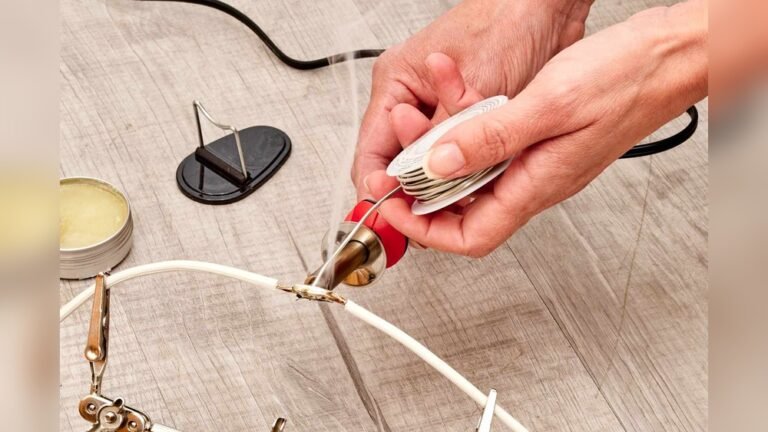
What Is Solder Wire? Your Essential Guide To Joining Metals
Solder wire is a fundamental material for anyone working with electronics, plumbing, or metal crafts. It’s the unsung hero that creates strong, reliable connections between metal parts. Without it, your circuit boards would be blank, and your pipes would leak.
But what exactly is solder wire, and how does it work? This guide will break down everything you need to know about this essential material, from its composition to its uses and how to choose the right type.
The Building Blocks Of Solder Wire
At its core, solder wire is a metal alloy designed to melt at a relatively low temperature. This low melting point is key to its function. When heated, the solder melts and flows into the gaps between the pieces of metal you want to join. As it cools, it solidifies, creating a strong electrical and mechanical bond.
Common Solder Alloys
The most common solder alloys are made from tin and lead. For many years, 60/40 tin-lead solder was the industry standard. This means it contained 60% tin and 40% lead. It was popular because it melts at a low temperature (around 183°C or 361°F) and wets surfaces easily, meaning it spreads out smoothly.
However, due to health concerns associated with lead, lead-free solders are now widely used, especially in consumer electronics. These typically use a higher percentage of tin, often combined with other metals like silver, copper, or bismuth. A common lead-free alloy is 99.3% tin, 0.7% copper. While lead-free solders are safer for the environment and human health, they often require higher soldering temperatures and can be a bit trickier to work with than traditional leaded solders.
Flux: The Secret Ingredient
You’ll often see solder wire described as “flux-cored.” Flux is a chemical cleaning agent that is crucial for a good solder joint. Metal surfaces, even those that look clean, have a thin layer of oxidation. This oxide layer prevents the molten solder from sticking properly. The flux, when heated, melts and burns away this oxidation, allowing the solder to flow freely and create a strong bond.
There are different types of flux, with rosin-based flux being the most common for electronics. Rosin is a natural resin derived from pine trees. This flux is typically contained within a core or multiple cores running through the center of the solder wire. After soldering, the flux residue is usually non-corrosive and can often be left in place, though cleaning is sometimes recommended for critical applications.

Credit: knowhow.napaonline.com
How Solder Wire Works: The Science Of Joining
The process of soldering relies on a few key scientific principles. When you heat the solder wire with a soldering iron, the heat is transferred to the metals you are joining. Once the base metals reach a temperature above the melting point of the solder and flux, both the solder and the flux begin to melt.
The flux cleans the surfaces of the metals, removing oxides and other contaminants. This process is called wetting. Good wetting means the molten solder spreads out evenly over the base metals, forming a strong metallurgical bond. The molten solder then flows into the microscopic spaces between the two pieces of metal, acting like a liquid glue.
As the joint cools down, the solder solidifies, creating a solid electrical and mechanical connection. The speed at which the joint cools can affect the quality of the solder joint. Cooling too slowly can sometimes result in a dull or grainy solder joint, which may be weaker.
Types Of Solder Wire
Solder wire comes in various diameters and types, each suited for different applications.
Diameter
The diameter of the solder wire is important. Thicker wires (like 1.5mm or 0.062 inches) are good for larger electrical connections or plumbing, where you need to deposit more solder quickly. Thinner wires (like 0.5mm or 0.020 inches) are ideal for delicate electronics work, such as soldering tiny surface-mount components where precision is essential.
Core Type
- Solid Core Solder: This type of solder wire does not contain flux. It’s used when you plan to add flux separately, often in plumbing applications or when using specific flux paste.
- Flux-Cored Solder: This is the most common type for electronics. The flux is contained within one or more hollow cores inside the wire.
- Rosin-Cored: Uses rosin-based flux, suitable for most electronics.
- Water-Soluble Flux-Cored: Uses flux that can be cleaned off with water. This is often used in industrial settings.
- No-Clean Flux-Cored: Leaves a residue that is generally non-corrosive and doesn’t need cleaning, saving time in production.
Lead-free Vs. Leaded Solder
As mentioned earlier, the choice between lead-free and leaded solder is significant.
| Feature | Leaded Solder (e.g., 60/40 Tin/Lead) | Lead-Free Solder (e.g., Sn-Cu, Sn-Ag-Cu) |
|---|---|---|
| Melting Point | Lower (approx. 183°C / 361°F) | Higher (approx. 217-227°C / 423-441°F) |
| Ease of Use | Generally easier to wet and flow | Can be harder to wet, requires higher temps |
| Joint Appearance | Often shiny and smooth | Can be duller, sometimes grainy |
| Health Concerns | Contains lead, a toxic heavy metal | Safer, no lead |
| Environmental | Lead is a pollutant | More environmentally friendly |
| Cost | Historically cheaper | Can be more expensive due to silver content |
A common lead-free alloy used in electronics is SAC305, which is approximately 96. 5% tin, 3% silver, and 0. 5% copper. This alloy offers good strength and reliability but requires higher soldering temperatures.

Credit: www.youtube.com
Applications Of Solder Wire
Solder wire is incredibly versatile and finds use in many different fields.
Electronics
This is perhaps the most well-known application. Solder wire is used to connect electronic components to printed circuit boards (PCBs), attach wires, and repair electronic devices. The conductivity of the solder joint is crucial for the proper functioning of electronic circuits. For very fine work, such as with microcontrollers or small sensors, a thin diameter solder wire (0.5mm or less) is essential.
Plumbing
In plumbing, solder is used to join copper pipes. Traditionally, lead-free solder is now required for potable water systems to prevent lead contamination. Plumbers often use a thicker gauge solid core wire and apply flux paste separately. The joint is then heated with a torch, and the solder is fed into the gap to create a watertight seal.
Stained Glass And Metal Art
Artisans use solder wire to join pieces of glass in stained glass windows or to assemble metal sculptures. The solder creates the dark lines in stained glass and holds metal components together in art pieces. Here, the appearance of the solder joint is often as important as its strength.
Automotive Repair
Solder can be used for certain automotive repairs, such as fixing minor electrical wiring issues or repairing some metal bodywork components.
Choosing The Right Solder Wire
Selecting the correct solder wire depends on your specific project and tools.
- Application: Are you working on electronics, plumbing, or something else? This is the most important factor.
- Leaded or Lead-Free: For electronics, consider lead-free for safety and environmental reasons, but be prepared for higher temperatures. For plumbing carrying drinking water, lead-free is mandatory.
- Flux Type: For general electronics, a rosin-core, no-clean, or water-soluble flux is usually best. For plumbing, you