
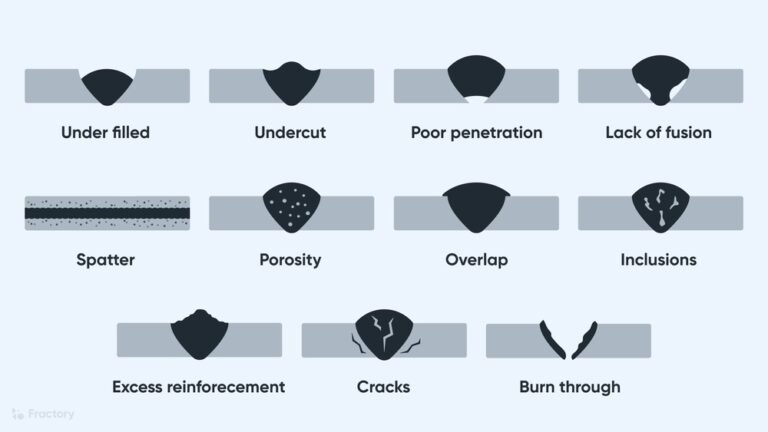
Welding is a common process used to join metals in industries like construction, automotive, and shipbuilding. But, even skilled welders can face problems called welding defects. These defects lower the strength, safety, and look of the welded parts. Understanding welding defect types helps people prevent mistakes, improve quality, and save time and money.
Common Welding Defects
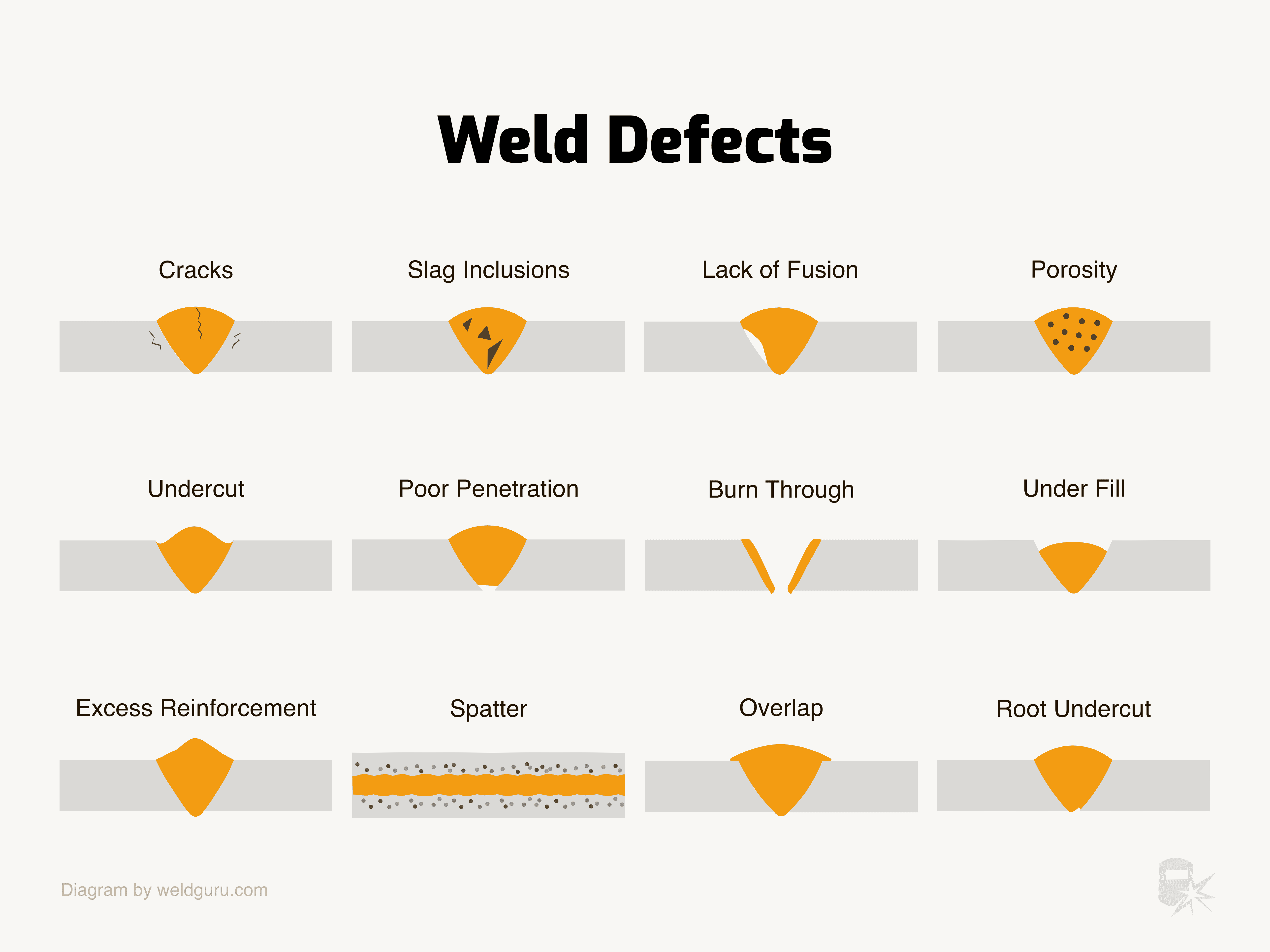
Welding defects are problems that happen during or after welding. They can be visible or hidden inside the weld. Here are the most common types:
1. Porosity
Porosity is when tiny holes or bubbles form in the weld. These come from trapped gas that cannot escape before the metal cools. Porosity weakens the weld and can cause leaks, especially in pipes.
Causes:
- Dirty surfaces
- Moisture in the welding area
- Wrong welding parameters
2. Cracks
Cracks are one of the most dangerous defects. They can appear right after welding or later under stress. Cracks can be found in the weld, in the base metal, or at the weld edges.
Types:
- Longitudinal cracks (along the weld)
- Transverse cracks (across the weld)
- Crater cracks (at the end of the weld bead)
3. Undercut
Undercut is a groove along the weld toe, where the base metal is melted away. This weakens the joint and can lead to more cracks.
Causes:
- High welding speed
- Too much heat
- Poor technique
4. Slag Inclusion
Slag inclusion happens when bits of flux or slag get trapped inside the weld. This prevents proper bonding and can cause failure under load.
Causes:
- Not cleaning between passes
- Wrong electrode angle
5. Incomplete Fusion
Incomplete fusion means the weld metal has not fully joined with the base metal or previous weld layers. This leaves weak spots that can break under pressure.
Causes:
- Low heat input
- Wrong electrode angle
- Surface contamination
6. Incomplete Penetration
Incomplete penetration is when the weld does not reach the root of the joint. This causes a weak connection, especially in structural welds.
Causes:
- Low heat input
- Incorrect joint preparation
- Fast welding speed
7. Excessive Spatter
Spatter is when tiny droplets of molten metal land outside the weld area. While not always dangerous, spatter makes the job look messy and can cause cleaning problems.
Causes:
- Wrong current settings
- Poor gas shielding
8. Overlap
Overlap is when the weld metal flows over the base metal without fusing. This creates a weak and ugly weld.
Causes:
- Slow welding speed
- Too much filler metal
Welding Defect Comparison
To see how defects affect quality, here is a comparison of their impact and frequency:
| Defect Type | Frequency | Impact on Strength |
|---|---|---|
| Porosity | Common | Medium |
| Cracks | Less Common | High |
| Undercut | Common | Medium |
| Slag Inclusion | Moderate | Medium |
| Incomplete Fusion | Moderate | High |
| Incomplete Penetration | Moderate | High |
| Excessive Spatter | Common | Low |
| Overlap | Less Common | Medium |

Credit: yeswelder.com
How To Detect Welding Defects
Detecting welding defects is important to ensure safety and quality. There are two main ways:
- Visual Inspection: Simple and fast. Checks for surface issues like cracks, undercut, and spatter.
- Non-Destructive Testing (NDT): Methods like X-ray, ultrasonic, and magnetic particle testing help find hidden defects.
Here’s a comparison of popular inspection methods:
| Inspection Method | Detects Surface Defects | Detects Internal Defects | Cost |
|---|---|---|---|
| Visual Inspection | Yes | No | Low |
| Ultrasonic Testing | No | Yes | Medium |
| X-ray Testing | No | Yes | High |
| Magnetic Particle Testing | Yes | Limited | Medium |
How To Prevent Welding Defects
Most welding defects can be avoided with careful planning and proper technique. Here are practical ways to prevent them:
- Clean surfaces: Always remove dirt, oil, and moisture before welding.
- Use correct parameters: Adjust heat, speed, and electrode angle to fit the material and joint.
- Check equipment: Make sure machines and tools are working well.
- Follow proper procedures: Stick to recommended welding methods for the material.
- Inspect between passes: Clean slag and check for defects after each weld pass.
Many beginners miss the importance of joint preparation. If the edges are not shaped or cleaned correctly, defects like incomplete penetration and fusion can easily happen. Another insight: Even the type of shielding gas can affect spatter and porosity, so always use the right gas for the welding process.
Credit: weldguru.com
Real-life Example
In 2014, a bridge in the US suffered failure due to cracks and incomplete fusion in its welds. The investigation found improper welding technique and lack of inspection as causes. This event showed how welding defects can lead to costly repairs and safety risks.
Frequently Asked Questions
What Is The Most Dangerous Welding Defect?
Cracks are the most dangerous because they can cause sudden failure, even under low stress. They are often hard to detect and can spread quickly.
Can Welding Defects Be Fixed?
Some defects like spatter or undercut can be fixed by grinding or rewelding. But deep defects like cracks or incomplete fusion often need cutting out and redoing the weld.
How Do Welding Defects Affect Product Safety?
Welding defects lower the strength and reliability of joints. They can cause leaks, breaks, or collapse, which is risky in structures, pipelines, and vehicles.
Why Do Beginners Often Face Porosity?
Beginners often forget to clean surfaces or use the wrong shielding gas. Moisture and dirt cause porosity, which weakens the weld and can cause leaks.
Where Can I Learn More About Welding Defects?
You can find detailed information and standards on welding defects at the Wikipedia Welding Defect page.
Welding defects are a big challenge in metal joining. Knowing the types, causes, and prevention methods can help you create safer, stronger, and better-looking welds. Careful inspection and attention to detail are key to avoiding costly mistakes and ensuring quality.

Credit: www.zintilon.com