
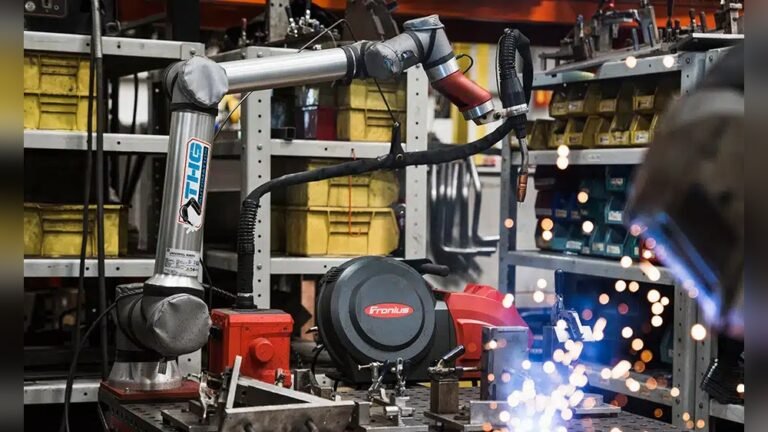
Cobot welding is changing the way factories and workshops produce metal products. Instead of relying only on human welders or traditional robots, manufacturers are now using collaborative robots—called cobots—to help weld faster, safer, and more accurately. This technology is not just for large companies. Even small businesses are starting to use cobot welding to save money and improve quality.
You may have seen videos of cobots working side by side with people. They look like friendly machines, often with arms that move smoothly. But what makes them special for welding? Let’s break down how cobot welding works, why it matters, and how it compares to old methods.
What Is Cobot Welding?
Cobot welding uses collaborative robots that can work safely with humans. Unlike traditional industrial robots, cobots do not need safety cages. They have sensors and smart software to detect humans nearby and adjust their movements. This allows welders to guide, teach, or monitor the cobot during welding.
Cobots are programmed for tasks like MIG welding, TIG welding, and spot welding. The operator can move the cobot arm to show it the welding path, then the cobot repeats the task automatically. This is called teach-and-repeat. Cobots can also be programmed through a touchscreen, making them user-friendly even for beginners.
Benefits Of Cobot Welding
Cobot welding brings many advantages for factories and workshops:
- Better safety: Cobots have sensors to stop if someone gets too close, reducing accidents.
- Higher productivity: Cobots can weld non-stop, leading to faster production.
- Consistent quality: Cobots follow the exact same path every time, reducing mistakes.
- Lower labor costs: Companies need fewer welders, saving money.
- Easy setup: Cobots are quick to install and program, even in small spaces.
Here’s a quick comparison between cobot welding and traditional welding:
| Feature | Cobot Welding | Manual Welding |
|---|---|---|
| Safety | High (sensors, automatic stop) | Medium (depends on worker care) |
| Speed | Fast, continuous | Slower, needs breaks |
| Quality | Consistent, repeatable | Varies with skill |
| Setup | Easy, quick | Manual, takes longer |

Credit: thgautomation.com
Cobot Welding Applications
Cobots are used in many industries, including:
- Automotive: Welding car frames and parts
- Aerospace: Precision welding for aircraft components
- Metal fabrication: Making furniture, tools, and equipment
- Electronics: Welding small metal parts
A real-world example: A small metal shop in Texas switched to cobot welding for making steel frames. They saw a 30% increase in productivity and fewer mistakes compared to manual welding. This shows cobots are not just for big companies.
How Cobot Welding Works
The process starts with setting up the cobot in the workspace. The operator then teaches the cobot the welding path by moving its arm. The cobot records this path and repeats it automatically. Some cobots use cameras or laser sensors to follow edges and adjust for errors.
Here’s a simple step-by-step breakdown:
- Place the cobot next to the workpiece.
- Guide the cobot arm along the desired weld line.
- Save the path using the cobot’s control panel.
- The cobot performs the weld using its built-in torch.
- Monitor the weld and make adjustments if needed.
A common mistake beginners make is not checking the workpiece alignment. Even a small tilt can cause the weld to miss the target. Always double-check before starting.
Comparing Cobot Welding Systems
There are many types of cobot welding systems. Some are designed for large production lines, while others fit small workshops. Here’s a comparison of popular cobot brands:
| Brand | Max Payload | Reach | Typical Price |
|---|---|---|---|
| Universal Robots UR10e | 10 kg | 1300 mm | $35,000 |
| FANUC CRX-10iA | 10 kg | 1240 mm | $30,000 |
| KUKA LBR iiwa | 14 kg | 820 mm | $70,000 |
Most cobots are designed to be flexible. If your shop makes many different parts, you can reprogram the cobot quickly. This is harder with traditional robots, which often need experts to change their programs.
Challenges And Limitations
While cobot welding is powerful, it does have some limits:
- Initial cost: Cobots are cheaper than large robots, but still cost $30,000–$70,000.
- Skill requirement: Operators need basic training, especially for programming.
- Not for all jobs: Cobots work best on simple, repeatable welds. Complex shapes may need manual welding.
Some shops try to use cobots for everything, but this can lead to problems. If the weld is in a tight space or needs special techniques, a human welder is often better.
Another insight: Cobots are not always faster than humans for small batches. Setting up the cobot takes time, so manual welding may be quicker for short runs.

Credit: denaliweld.com
Industry Trends And Data
The market for cobot welding is growing quickly. In 2026, the global cobot market was valued at over $1.5 billion and is expected to reach $3.5 billion by 2027. More than 40% of new cobots are used for welding tasks.
Companies report up to 50% reduction in rework (fixing mistakes) when using cobots. This means less wasted material and lower costs.
If you want to learn more about cobot welding trends and data, visit the Robotics Industry Association.
Frequently Asked Questions
What Is A Cobot?
A cobot is a robot designed to work safely with humans. It uses sensors and smart software to avoid accidents.
Is Cobot Welding Safe?
Yes. Cobots have built-in safety features. They stop or slow down if someone gets too close. This makes them safer than traditional robots.
How Much Does A Cobot Welding System Cost?
Most cobot welding systems cost between $30,000 and $70,000. Prices depend on brand, features, and payload.
Can Cobot Welding Replace Human Welders?
Cobots can handle repetitive, simple welds. But for complex or unique jobs, human welders are still needed.
What Training Is Needed To Use Cobot Welding?
Operators need basic training in robot programming and welding techniques. Most cobots are designed to be easy to learn.
Cobot welding is a smart way to boost productivity, improve safety, and deliver high-quality welds. As the technology improves, more workshops and factories will start using cobots. If you want to stay competitive, it is worth learning about cobot welding and how it can fit into your business.

Credit: www.thefabricator.com