
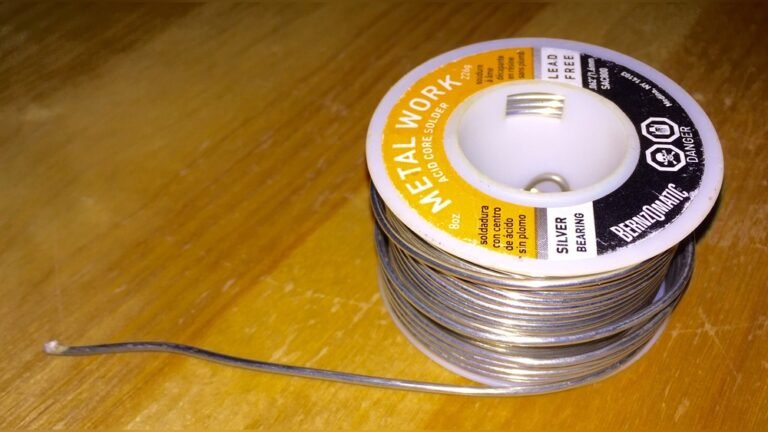
Solder wire is a crucial material in electronics, used to join metal components together. It’s essentially a metal alloy that melts at a relatively low temperature, allowing it to flow and create a strong electrical and mechanical connection. Understanding what solder wire is made of helps in choosing the right type for specific applications, from delicate circuit boards to robust plumbing.
The Core Components Of Solder Wire
At its heart, solder wire is a mixture of metals, carefully chosen for their melting points, flow characteristics, and the strength of the bond they create. The most common base metals used in solder are tin and lead. However, due to health and environmental concerns, lead-free solders are now widely used.
Tin: The Foundation Of Solder
Tin is a soft, silvery-white metal that is a primary ingredient in most solders. Its low melting point makes it ideal for joining electronic components without damaging them. Pure tin melts at around 232°C (449. 6°F). When alloyed with other metals, the melting point can be adjusted.
Lead: The Traditional Alloying Agent
For many years, lead was a common partner to tin in solder alloys, typically in a 60% tin, 40% lead (60/40) ratio. Lead significantly lowers the melting point of the alloy, making soldering easier and creating a smooth, shiny joint.
A 60/40 tin-lead solder melts around 183°C (361. 4°F). This lower melting point is beneficial for working with temperature-sensitive electronic parts.
However, lead is a toxic heavy metal, and its use in electronics is now restricted in many regions due to environmental and health regulations, such as the Restriction of Hazardous Substances (RoHS) directive in the European Union.
The Rise Of Lead-free Solder
The demand for safer and more environmentally friendly soldering practices has led to the widespread adoption of lead-free solder. These alloys replace lead with other metals, often creating different performance characteristics and requiring slight adjustments in soldering technique.
Common Lead-free Alloys
Lead-free solders are typically based on tin but alloyed with other metals like silver (Ag), copper (Cu), and sometimes bismuth (Bi) or indium (In). These additions help to achieve a low melting point and good mechanical properties similar to leaded solders.
SAC Alloys: One of the most common types of lead-free solder is the SAC alloy family, which stands for Tin-Silver-Copper.
- SAC305 is a popular example, containing approximately 3.0% silver and 0.5% copper, with the remainder being tin. SAC305 has a melting point around 217-220°C (423-428°F).
- SAC405 contains 4.0% silver and 0.5% copper.
These alloys offer good strength and fatigue resistance. However, they generally have a higher melting point than traditional leaded solders, which can be a consideration for some applications.
Other Lead-free Solder Types
- Tin-Copper (Sn-Cu) Alloys: These are often used in electronics manufacturing as a more cost-effective lead-free option. They typically contain about 0.7% copper. Their melting point is around 227°C (440.6°F).
- Tin-Silver (Sn-Ag) Alloys: Pure tin-silver solders, like Sn96.5Ag3.5 (96.5% tin, 3.5% silver), have a melting point of about 221°C (430°F). They are known for their strength but can be more expensive due to the silver content.
- Tin-Bismuth (Sn-Bi) Alloys: These alloys have very low melting points, sometimes as low as 138°C (280.4°F) for Sn42Bi58 (42% tin, 58% bismuth). They are useful for temperature-sensitive components or for rework applications. However, bismuth solders can be more brittle than tin-lead or SAC alloys.
Here’s a comparison of common solder types:
| Solder Type | Typical Composition | Melting Point (°C) | Melting Point (°F) | Key Characteristics |
|---|---|---|---|---|
| **60/40 Tin-Lead** | 60% Tin, 40% Lead | 183 | 361.4 | Easy to use, low melting point, shiny joint, toxic |
| **SAC305** | 96.5% Tin, 3% Silver, 0.5% Copper | 217-220 | 423-428 | Strong, good fatigue resistance, higher melting point |
| **Sn-Cu (Lead-Free)** | ~99.3% Tin, ~0.7% Copper | 227 | 440.6 | Cost-effective lead-free, good for wave soldering |
| **Sn-Ag (Lead-Free)** | 96.5% Tin, 3.5% Silver | 221 | 430 | Strong, good electrical conductivity, higher cost |
| **Sn-Bi (Lead-Free)** | 58% Bismuth, 42% Tin | 138 | 280.4 | Very low melting point, good for sensitive components, brittle |
Credit: vectorbluehub.com
The Role Of Flux In Solder Wire
Most solder wire contains a flux core. Flux is a chemical cleaning agent that is essential for successful soldering. Metal surfaces, especially when heated, can oxidize (form a layer of metal oxide). This oxide layer prevents the molten solder from wetting and bonding to the metal.
What Flux Does
The flux core does several things during the soldering process:
- Cleans the Surface: It removes existing oxides from the metal surfaces to be joined.
- Prevents Re-oxidation: As the joint is heated, the flux forms a protective barrier, preventing new oxides from forming.
- Improves Wetting: It reduces the surface tension of the molten solder, allowing it to flow more easily and spread over the metal surfaces.
Types Of Flux
Fluxes are typically made from rosin (a natural resin), activators (chemicals that help remove oxides), and solvents. The type of flux determines its activity and how it behaves when heated.
- Rosin Mildly Activated (RMA): This is a common type for electronics. It’s less corrosive than more active fluxes but still effective for most clean electronic assemblies.
- Rosin Activated (RA): This flux is more aggressive and suitable for slightly oxidized surfaces.
- No-Clean Flux: These fluxes are designed to leave minimal residue after soldering, which is often acceptable in modern electronics manufacturing. The residue is typically non-corrosive and non-conductive.
- Water-Soluble Flux: These fluxes are highly active and easy to clean but require thorough rinsing with water after soldering to prevent corrosion.
The flux is usually extruded into the center of the solder wire, creating one or more continuous cores. The amount of flux is often specified by the manufacturer, for example, “60/40 rosin core solder. “
Other Solder Wire Compositions
While tin, lead, silver, copper, and flux are the main ingredients, some specialized solder wires might contain small amounts of other metals to achieve specific properties.
- Antimony (Sb): Sometimes added to tin-lead solders to increase hardness and reduce creep (permanent deformation under stress).
- Bismuth (Bi): As mentioned, used to lower melting points significantly. It can also be added in small amounts to other alloys.
- Ind