
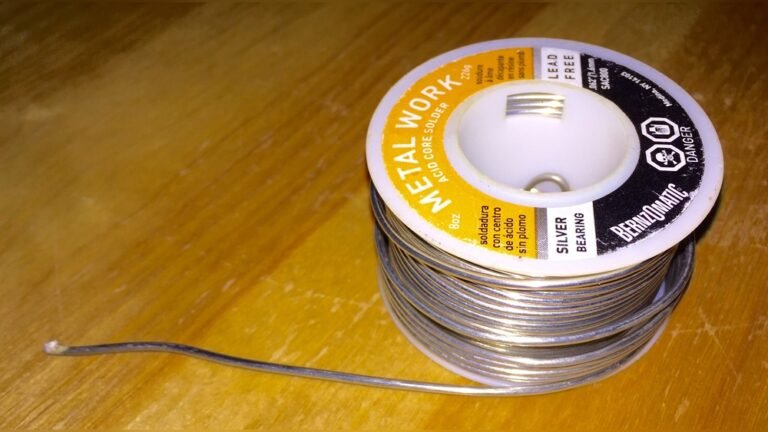
Choosing the right soldering wire is crucial for successful and durable electronic connections. The material of the solder wire significantly impacts its melting point, flow characteristics, and the strength of the final joint. Different applications demand different solder compositions, making it essential to understand the options available.
Soldering wire, often called solder or solder alloy, is a fusible metal alloy used to create a permanent electrical connection between electronic components. It’s typically composed of tin and lead, though lead-free alternatives are now widely used due to environmental and health concerns. The properties of the solder alloy, such as its melting point, viscosity, and wettability, are directly determined by its constituent metals and their proportions. Understanding these materials helps you select the best solder for your specific project, ensuring reliability and longevity.
Understanding Solder Composition
The primary components of most soldering wires are tin and lead. However, other metals are often added in smaller amounts to modify the alloy’s properties, such as improving its flow, increasing its strength, or lowering its melting point.
Tin (sn)
Tin is the most important element in solder alloys. It has a relatively low melting point, which makes it ideal for soldering electronic components that can be sensitive to high temperatures. Pure tin melts at 231. 9 °C (449. 5 °F).
Lead (pb)
Lead is traditionally added to tin to lower the melting point of the alloy and improve its wetting properties, meaning it spreads more easily over the surfaces being joined. A common tin-lead alloy, like 60/40 (60% tin, 40% lead), melts at a lower temperature than pure tin.
However, due to health concerns, leaded solder is being phased out in many regions.
Other Alloying Elements
To enhance performance, various other metals are added to solder alloys in small percentages:
- Silver (Ag): Adding silver, typically around 1-3%, increases the mechanical strength of the solder joint and improves its creep resistance. It also slightly raises the melting point. Solder with silver is often used in applications requiring high reliability, such as in the aerospace industry.
- Copper (Cu): Copper is often added to lead-free solders, especially those based on tin. It helps to reduce the dissolution of copper from printed circuit boards (PCBs) during soldering, preventing the solder from becoming brittle. It also improves the thermal fatigue resistance of the joint.
- Antimony (Sb): Antimony can be added to improve the mechanical properties and reduce the dross formation on the surface of molten solder. It can also help to prevent tin pest, a form of degradation that can occur in tin-rich alloys at low temperatures.
- Bismuth (Bi): Bismuth can be used to significantly lower the melting point of tin-based solders, creating eutectic or near-eutectic alloys with very low melting points. This is useful for soldering temperature-sensitive components.
- Indium (In): Indium is sometimes added to create solders with very low melting points or to improve ductility and thermal shock resistance. However, indium is expensive, so it’s used in specialized applications.
Types Of Soldering Wire
Soldering wires are broadly categorized into two main types based on their composition: leaded and lead-free.
Leaded Solder
Leaded solder alloys, most commonly 60/40 tin/lead and 63/37 tin/lead, have been the standard for decades. The 63/37 alloy is eutectic, meaning it melts and solidifies at a single, constant temperature (183 °C or 361 °F). This provides a sharp melting point, which is advantageous for soldering.
Properties of Leaded Solder:
- Low Melting Point: Easier to work with, less risk of damaging components.
- Excellent Wetting: Spreads easily and forms strong, shiny joints.
- Good Mechanical Strength: Provides durable connections.
Drawbacks: The primary concern is the toxicity of lead, which poses health and environmental risks.
Lead-free Solder
Lead-free solder alloys have become increasingly prevalent due to regulations like the Restriction of Hazardous Substances (RoHS) directive. These alloys are typically tin-based, with additions of copper, silver, bismuth, or other elements to achieve desired properties.
Common lead-free alloys include:
- SAC Alloys (Tin-Silver-Copper): These are the most common lead-free solders. SAC305 (96.5% tin, 3% silver, 0.5% copper) is a popular choice, offering good mechanical strength and reliability. However, it has a higher melting point (around 217-220 °C or 423-428 °F) than leaded solder.
- Tin-Bismuth Alloys: These alloys have very low melting points, sometimes below 138 °C (280 °F), making them suitable for heat-sensitive applications. However, they can be more brittle than SAC alloys.
- Tin-Zinc Alloys: These are less common but offer good solderability and mechanical properties. They are often used in specific industrial applications.
Properties of Lead-Free Solder:
- Environmentally Friendly: Eliminates the use of hazardous lead.
- Higher Melting Point: Generally requires higher soldering temperatures, which can be a challenge for some components and equipment.
- Potentially More Brittle Joints: Some lead-free alloys can form joints that are more prone to cracking under stress or vibration compared to leaded solder.
- Dross Formation: Can sometimes form more dross (oxide layer) on the molten solder surface, requiring more frequent cleaning.

Credit: www.sciencebuddies.org
Key Properties To Consider
When selecting soldering wire, several properties are critical for achieving good results.
Melting Point
The melting point is the temperature at which the solder transitions from solid to liquid. This is perhaps the most defining characteristic.
- Low Melting Point (e.g., 183°C for 63/37 Sn/Pb): Easier to work with, requires less heat, reducing the risk of damaging sensitive components or the PCB.
- High Melting Point (e.g., 217-220°C for SAC305): Requires higher soldering iron temperatures, more heat input, and can increase the risk of thermal damage.
Wettability
Wettability refers to how well the molten solder spreads over the surfaces being joined. Good wettability is essential for forming a strong, reliable electrical and mechanical bond.
- Solder with good wettability flows smoothly and creates a shiny, smooth joint.
- Poor wettability results in solder balls, uneven coverage, and weak joints. Leaded solders generally offer superior wettability compared to many lead-free alternatives.
Joint Strength And Reliability
The mechanical strength of the solder joint is vital, especially in applications subject to vibration or physical stress.
- Additions of silver (Ag) to tin-lead or tin-silver-copper alloys significantly improve joint strength and resistance to creep.
- Lead-free solders, particularly SAC alloys, offer good strength, but some may be more brittle than traditional leaded solder.
Flux Core
Most soldering wires contain a flux core. Flux is a chemical cleaning agent that removes oxidation from the metal surfaces and the solder itself, allowing the molten solder to flow and bond properly.
- Rosin-based fluxes are common for electronics. They are categorized by their activity and residue type:
- R (Rosin): Contains organic acids.
- RA (Rosin Activated): Contains stronger activators for better cleaning.
- RMA (Rosin Mildly Activated): Offers a balance between cleaning power and residue corrosivity.
- No-Clean Flux: Leaves a minimal residue that is typically non-corrosive and doesn’t need to be cleaned off. This is convenient but may not provide the same