
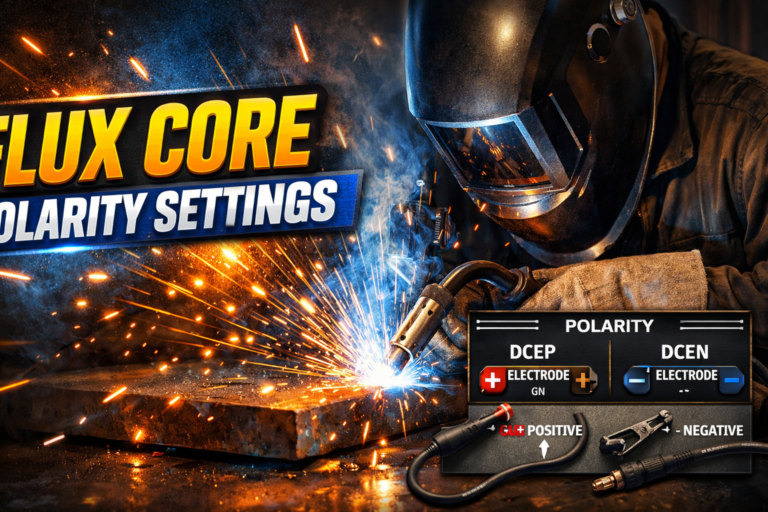
Flux core welding is popular for its speed, versatility, and ability to work outdoors. But many beginners struggle with one detail: flux core polarity settings. Get this wrong, and your welds will be weak, splattered, or just not stick. Understanding polarity is key to getting clean, strong welds every time you pick up the gun.
What Is Flux Core Welding Polarity?
Polarity in welding means the direction that electrical current flows. In flux core welding, this impacts how the arc forms, how the wire melts, and how well the shielding works. There are two main settings:
- DCEN (Direct Current Electrode Negative): Electrode (wire) is negative, work clamp is positive. Also called straight polarity.
- DCEP (Direct Current Electrode Positive): Electrode is positive, work clamp is negative. Also called reverse polarity.
Most flux core wires are designed for DCEN, but a few need DCEP. Choosing the wrong polarity leads to poor penetration and excess spatter.
Standard Polarity Settings For Flux Core
Most self-shielded flux core wires use DCEN. This is different from MIG welding, where DCEP is standard. Here’s a quick comparison:
| Welding Process | Usual Polarity | Result if Wrong |
|---|---|---|
| Self-shielded Flux Core (FCAW-S) | DCEN | Poor weld, more spatter |
| Gas-shielded Flux Core (FCAW-G) | DCEP | Lack of fusion, weak weld |
| MIG (GMAW) | DCEP | Poor arc, wire stubbing |
Key Insight: Many new welders accidentally use DCEP for self-shielded wire because MIG uses DCEP. Always check your wire’s label.
How To Set Polarity On Your Welder
Most modern welders let you switch polarity by swapping the work clamp and gun leads inside the machine. Here’s how:
- Turn off the welder. Always cut power before opening the case.
- Open the access panel. Look for labeled terminals (usually “+” and “–”).
- Check the wire type. Read the spool or packaging.
- Attach the gun lead to the correct terminal. For most self-shielded flux core, this is the negative (“–”).
- Connect the work clamp to the other terminal.
- Close the panel and power up.
Some hobby welders have a switch instead of terminals. Consult the manual if you’re unsure.
Why Polarity Matters
Wrong polarity isn’t just a minor mistake. It directly affects:
- Penetration: DCEN gives deeper welds with self-shielded wire.
- Spatter: Wrong polarity increases spatter and cleanup.
- Wire burn-off: Incorrect settings cause unstable arc and wire stubbing.
- Shielding: Polarity impacts the effectiveness of the flux in protecting the weld.
Here’s what happens if you use the wrong polarity:
| Polarity Used | Expected Result | Common Problems |
|---|---|---|
| DCEN (correct for most flux core) | Good bead, deep penetration | Minimal spatter |
| DCEP (wrong for self-shielded) | Shallow bead, poor fusion | Heavy spatter, porosity |
Non-obvious tip: Some wires are “dual-shielded” (need both flux and gas). These usually need DCEP. Always check the wire’s specs.
Common Flux Core Wire Types And Their Polarity
Not all wires use the same polarity. Here are some examples:
- E71T-11: Most popular self-shielded wire. Requires DCEN.
- E71T-1: Gas-shielded (needs external CO2 or mix). Requires DCEP.
- E71T-GS: For thin metal, DCEN.
- E70T-4: Heavy-duty, DCEN.
- E71T-12: Structural, DCEP.
Manufacturers always print polarity on the wire label. If you use the wrong type, your welds can fail under stress.
How To Identify And Fix Polarity Problems
Sometimes, you realize too late that polarity is wrong. Here’s how to spot it:
- Lots of spatter: Much more than normal.
- Porous welds: Bubbles and holes in the bead.
- Wire keeps sticking: Arc is unstable, wire “stubs” into the metal.
- Shallow welds: Bead sits on top, no fusion.
If you see these signs:
- Stop welding.
- Check the wire type and settings.
- Switch polarity if needed.
- Test on scrap metal before continuing.
Practical insight: Sometimes, wires from different brands with the same code may need different settings. Always read the label.
Tips For Better Flux Core Welds
- Clean your metal: Dirt and rust cause problems even with flux core.
- Use the right wire speed and voltage: Too fast or too slow creates issues.
- Keep your gun angle steady: 10-15 degrees from vertical is ideal.
- Do test welds on scrap: Before starting your main project.
- Store wire properly: Moisture ruins flux core wire.
Frequently Asked Questions
What Happens If I Use The Wrong Polarity With Flux Core Welding?
Using the wrong polarity usually causes excess spatter, weak welds, and poor penetration. The weld bead might look uneven or have holes. Always set the correct polarity for your wire.
How Do I Know Which Polarity My Flux Core Wire Needs?
Read the label on your wire spool or packaging. It will say DCEN or DCEP. You can also check the manufacturer’s data sheet. If you cannot find it, search for the wire code online. For further details, see this Wikipedia page on flux-cored arc welding.
Can I Weld Stainless Steel With Flux Core Wire, And Does Polarity Matter?
Yes, you can weld stainless steel with special flux core wires. Polarity is critical—some wires need DCEP, others DCEN. Always use the setting listed on the wire’s label.
Is Flux Core Polarity The Same As Mig Welding Polarity?
No, it’s usually different. MIG welding (solid wire with gas) uses DCEP, while most self-shielded flux core wires use DCEN. Mixing them up causes bad welds.
What Should I Do If I’m Still Getting Bad Welds After Setting The Correct Polarity?
Check for other issues: wire quality, incorrect voltage or wire speed, dirty metal, or a worn-out contact tip. Try a different wire brand if problems continue.
Getting polarity right with flux core welding takes a few extra minutes, but it saves hours of frustration. By knowing your wire, double-checking your settings, and understanding how polarity affects your welds, you’ll get strong, clean results every time.