
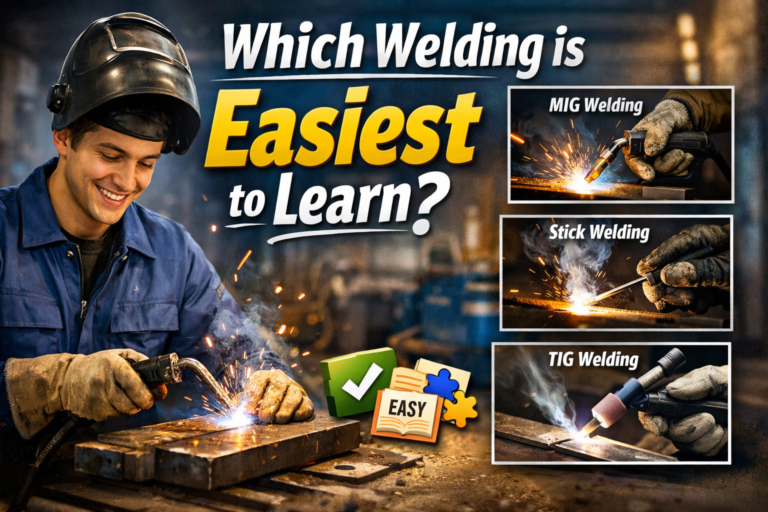
Learning to weld opens doors for hobbyists, workers, and anyone curious about metalwork. But welding can look intimidating at first. With several welding types, beginners often wonder, which welding is easiest to learn? Choosing the right method saves time, money, and frustration.
Many people think welding needs years of training. The truth is, some welding techniques are beginner-friendly and can be mastered quickly. This article compares popular welding styles, explains what makes one easier than another, and gives real advice to help you start strong.
Main Welding Types: Quick Overview
There are four main welding methods people use:
- MIG welding (GMAW)
- Stick welding (SMAW)
- TIG welding (GTAW)
- Flux-cored arc welding (FCAW)
Each has unique tools, skills, and learning curves. Understanding the basics helps you choose wisely.
| Welding Type | Skill Level | Equipment Cost | Typical Use |
|---|---|---|---|
| MIG | Beginner | Medium | Automotive, light fabrication |
| Stick | Intermediate | Low | Outdoor, repairs |
| TIG | Advanced | High | Precision, stainless, aluminum |
| Flux-cored | Beginner | Medium | Outdoor, thick metals |
Why Mig Welding Is Easiest
Most experts agree MIG welding is the easiest to learn. Here’s why:
- Simple setup: You only need a MIG welder, wire, shielding gas, and safety gear.
- Automatic feed: The wire feeds automatically, so you focus on guiding the gun.
- Clean process: Less spatter and cleanup compared to stick welding.
- Smooth learning curve: Many beginners get strong welds after just a few hours of practice.
MIG welding is forgiving. Even if your hand shakes or your speed changes, the weld usually holds. This makes it ideal for home projects or entry-level jobs.
Mig Vs Stick: What’s Easier For Beginners?
Stick welding is popular for repairs and outdoor work. It’s cheaper but harder to master. Stick welders must keep the electrode at the right angle and distance. Mistakes cause the rod to stick, making frustration common.
| Feature | MIG | Stick |
|---|---|---|
| Setup time | Quick | Moderate |
| Control needed | Low | High |
| Cleanup | Minimal | More |
| Beginner success | High | Low |
Tig And Flux-cored: Why They’re Not First Choices
TIG welding gives beautiful, precise welds. But it’s tough for new welders. You must control the torch, filler rod, and foot pedal. Even small mistakes ruin the weld.
Flux-cored welding is similar to MIG, but uses a special wire with flux inside. It’s easier than stick, but still messier than MIG. Beginners sometimes like it for outdoor jobs, since it works without gas.
What Makes Welding Easy?
Welding feels easy when:
- The equipment is user-friendly
- The process is simple and repeatable
- Mistakes are less likely to ruin the project
MIG welding checks all these boxes. You hold the gun, pull the trigger, and let the machine do the work. For most people, seeing the results fast boosts confidence.
Real-life Example: Mig Success Story
A college student named Alex wanted to build a go-kart frame. He tried stick welding and got frustrated after two days—rods stuck, welds broke. He switched to MIG, practiced for one hour, and finished his frame in a weekend. This shows how MIG welding helps beginners succeed quickly.
Common Mistakes Beginners Make
No matter which welding you choose, beginners often:
- Skip safety gear: Always use a helmet, gloves, and jacket.
- Rush the weld: Move slowly and steadily.
- Ignore machine settings: Wrong voltage or wire speed causes weak welds.
- Fail to clean metal: Dirt and rust ruin welds.
- Hold the gun at the wrong angle: Keep it at 10-15 degrees for MIG.
Avoiding these mistakes makes any welding easier. But with MIG, errors are less severe and easier to fix.
Equipment Costs And Accessibility
MIG welders cost $200–$600 for basic models. Stick welders can be cheaper ($100–$300), but require more skill. TIG welders are expensive ($800+), and flux-cored machines are similar in price to MIG.
For those starting at home or on a tight budget, MIG welding offers balance. It’s not the cheapest, but for ease and quick results, it’s worth the investment.
| Welding Type | Average Starter Cost (USD) | Learning Time (hours) | Beginner Success Rate (%) |
|---|---|---|---|
| MIG | $350 | 2–5 | 80 |
| Stick | $200 | 5–10 | 50 |
| TIG | $900 | 10–20 | 30 |
| Flux-cored | $350 | 3–7 | 60 |
Non-obvious Insights
Many beginners overlook two key points:
- Practice beats theory: Watching videos helps, but hands-on practice is the real teacher. Even ten minutes a day boosts skill fast.
- Metal thickness matters: MIG welding works best on thin to medium metals. If your project uses thick steel, stick or flux-cored may be better.
Also, don’t ignore the importance of comfort. MIG guns are lighter and easier to hold, reducing fatigue during long sessions.
Frequently Asked Questions
What Is The Easiest Welding For Beginners?
MIG welding is easiest for most beginners. It’s simple to set up, forgiving, and produces strong welds quickly.
Can I Learn Mig Welding By Myself?
Yes. Many people learn MIG welding at home with online videos, books, and practice. For extra help, try local classes or community workshops.
Is Mig Welding Safe For Beginners?
MIG welding is safe if you use proper safety gear—helmet, gloves, jacket, and work in a well-ventilated area. Never weld without protection.
How Long Does It Take To Learn Mig Welding?
Most people get decent results after 2–5 hours of practice. Mastery takes longer, but basic joints and repairs are possible in a weekend.
Where Can I Find More Information About Welding?
For in-depth guides, visit the Wikipedia Welding page. It covers all welding types and offers advanced details.
Choosing the right welding method makes your journey smoother. For most beginners, MIG welding is the clear winner. It’s fast, easy, and gives satisfying results. With practice, patience, and the right equipment, anyone can learn to weld and enjoy new skills for life.