
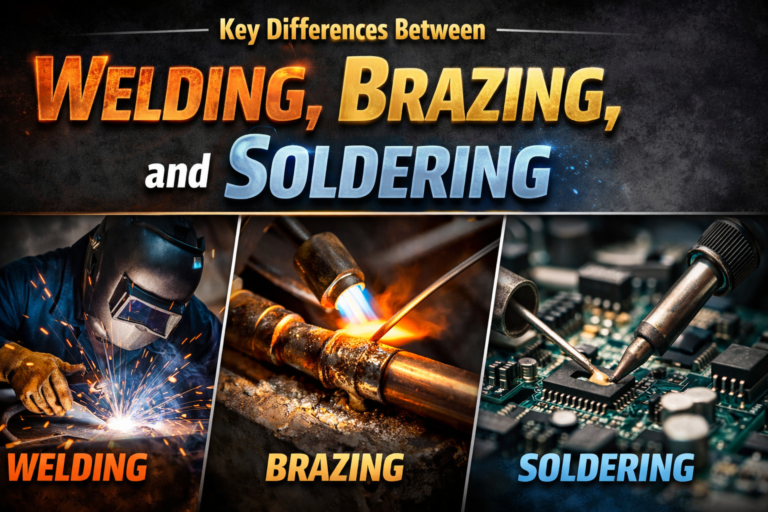
If you want to join two pieces of metal, you will hear about welding, brazing, and soldering. But what do these words mean? And how are they different from each other? This article will explain these three processes in simple words.
Introduction to Joining Metals
Many things around us are made by joining metals. For example, cars, bridges, and furniture. To join metals, people use different ways. The most common ways are welding, brazing, and soldering.
Even though these three ways join metals, they are not the same. Each way uses a different method and works best for certain jobs. Let’s learn about each one.
What is Welding?
Welding is a process where two pieces of metal are joined by melting them together. The edges of the metals get hot and melt. When they cool down, they become one strong piece.
Welding uses very high heat. This heat can come from an electric arc, flame, or other sources. The heat melts both the base metals and sometimes a filler metal. The filler metal helps fill the gap between the pieces.
Welding makes a strong and permanent bond. It is used in building cars, ships, and buildings. It works well for thick metals.
How Welding Works
- Heat melts the edges of the metals.
- Molten metal from filler or base metal fills the gap.
- The melted metal cools and solidifies.
- The pieces become one solid part.
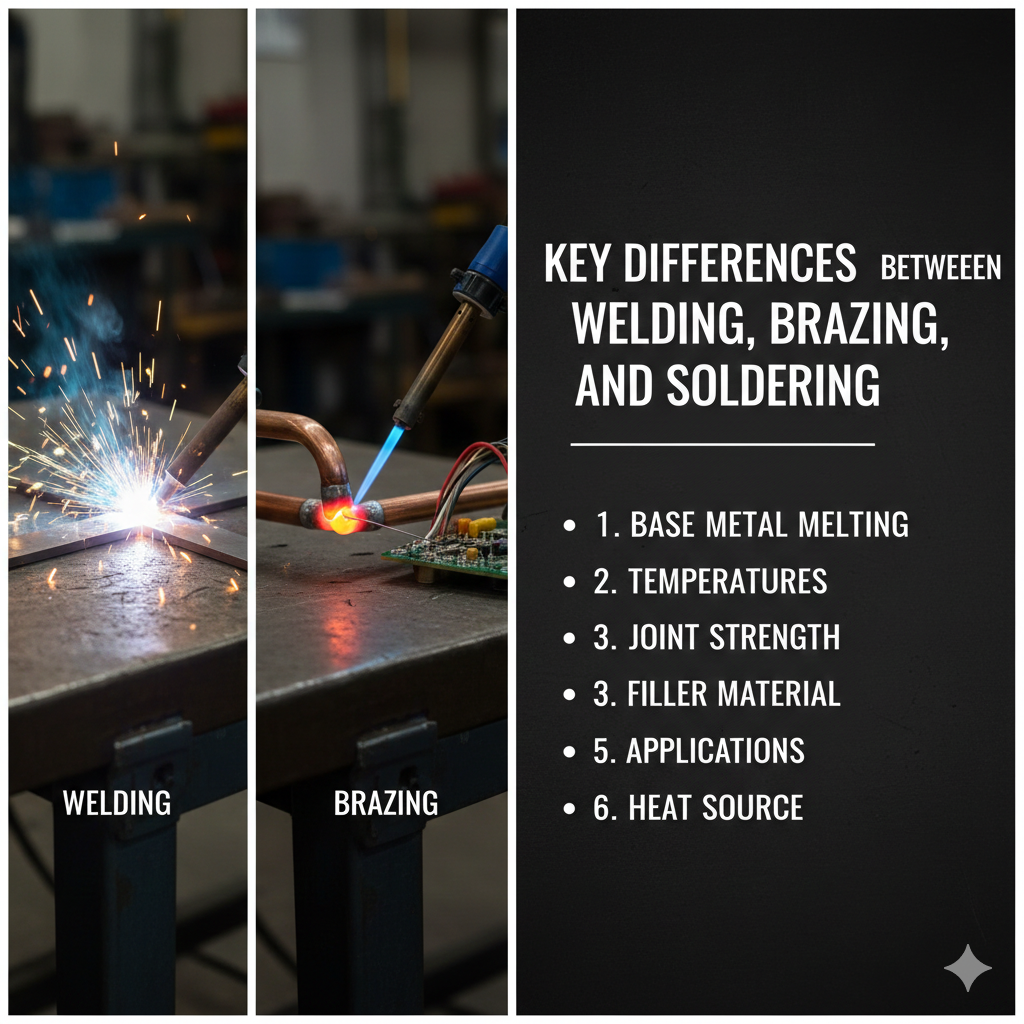
Types Of Welding
There are many types of welding. The most common are:
- Arc welding: Uses electric current to make an arc.
- MIG welding: Uses a wire as filler metal.
- TIG welding: Uses a tungsten electrode to make the arc.
- Gas welding: Uses a flame from burning gas.
What is Brazing?
Brazing is a joining process that uses heat to melt a filler metal. But unlike welding, the base metals do not melt.
The filler metal melts at a temperature above 450°C (about 840°F). The filler metal flows into the space between the two base metals. When it cools, it sticks the metals together.
Brazing works well for joining metals that do not melt easily. It also makes a strong joint but not as strong as welding.
How Brazing Works
- Heat warms the base metals, but they do not melt.
- The filler metal melts and flows between the pieces.
- The filler metal cools and bonds the metals.
Brazing is used in making pipes, tools, and jewelry. It works well for thin or dissimilar metals.
What is Soldering?
Soldering is similar to brazing but uses lower heat. The filler metal used in soldering melts below 450°C (about 840°F).
The base metals do not melt in soldering. The melted filler metal flows into the joint and joins the pieces when cool.
Soldering is used in electronics, plumbing, and small metal parts. It is good for delicate work and thin metals.
How Soldering Works
- Heat warms the metals but does not melt them.
- The solder melts and fills the joint.
- The solder cools and holds the metals together.
Key Differences Between Welding, Brazing, and Soldering
| Feature | Welding | Brazing | Soldering |
|---|---|---|---|
| Heat Used | Very high (melts base metals) | High (melts filler metal only) | Low (melts filler metal only) |
| Base Metals | Melts and fuses base metals | Does not melt base metals | Does not melt base metals |
| Filler Metal | May or may not use filler metal | Uses filler metal | Uses filler metal |
| Strength of Joint | Strongest | Strong but less than welding | Weaker than brazing and welding |
| Temperature Range | Above 1,300°C (2,372°F) | Above 450°C (840°F) | Below 450°C (840°F) |
| Common Uses | Heavy metals, construction, automotive | Pipe fittings, tools, jewelry | Electronics, plumbing, small metal parts |
Why Choose One Process Over Another?
Each process has its own good points. Choosing depends on the job and materials.
- Welding is best for very strong joints and thick metals.
- Brazing works well when you want a strong joint but less heat.
- Soldering fits for delicate parts and low heat needs.
Also, the tools and skills needed for each process are different. Welding needs more heat and safety gear. Brazing and soldering are easier for small jobs.
Summary
To join metals, welding, brazing, and soldering are common methods.
Welding melts the base metals to make a strong bond.
Brazing melts only the filler metal, joining the pieces without melting the base metals.
Soldering uses the lowest heat and melts a filler metal to join parts.
Each process fits different jobs. Welding for strong, heavy work. Brazing for medium strength and different metals. Soldering for delicate, low heat work.
Now you know the main differences. This helps you understand how metals join around you.
Frequently Asked Questions
What Is The Main Difference Between Welding, Brazing, And Soldering?
Welding melts base metals to join them. Brazing and soldering use filler metals without melting the base. Brazing needs higher heat than soldering.
Which Process Creates The Strongest Metal Joints?
Welding creates the strongest joints by melting and fusing metals. Brazing and soldering make weaker joints since they don’t melt base metals.
Can Welding, Brazing, And Soldering Join Different Metals?
Yes, all can join different metals. Brazing and soldering work better for dissimilar metals because they use filler metals.
What Temperature Range Is Used In Brazing?
Brazing usually happens above 450°C (840°F) but below the metal melting point. This heat melts the filler metal to join parts.