
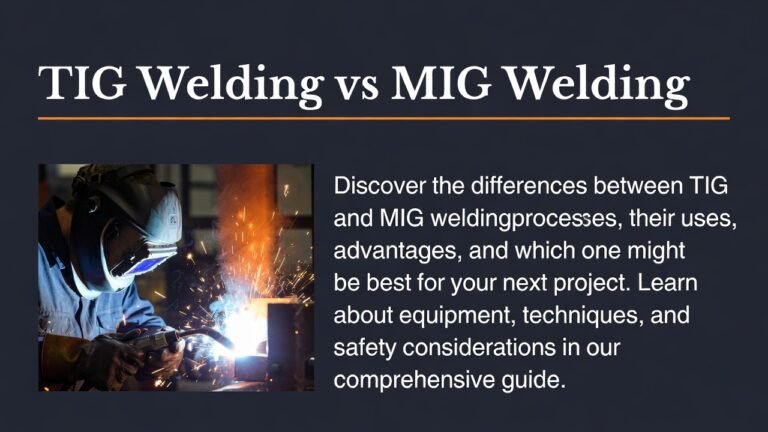
Welding is the process of joining two pieces of metal. It uses heat to melt the edges, which then stick together when cooled. Two popular types are TIG welding and MIG welding. Both have their own uses and benefits. But which one is right for your project? Let’s explore the main differences in simple words.
What is TIG Welding?
TIG stands for Tungsten Inert Gas welding. It uses a thin, non-consumable tungsten electrode to create the weld. The welder also uses a filler rod to add metal to the joint if needed. An inert gas, usually argon, flows around the weld to stop it from reacting with air.
TIG welding is known for making very clean and precise welds. It works well on thin metals and special metals like aluminum and stainless steel. Because the heat is controlled carefully, it does not burn the metal easily.
What is MIG Welding?
MIG means Metal Inert Gas welding. It uses a wire that feeds automatically through a welding gun. This wire melts and joins the metals together. Like TIG, MIG also uses an inert gas to protect the weld from air.
MIG welding is faster and easier to learn than TIG. It is good for thicker metals and big jobs. The wire keeps feeding, so the welder does not have to stop often. This helps finish work quickly.
How Do TIG and MIG Welding Work?
| Feature | TIG Welding | MIG Welding |
|---|---|---|
| Electrode Type | Non-consumable tungsten electrode | Consumable wire electrode |
| Filler Material | Added manually with filler rod | Wire acts as filler automatically |
| Speed | Slow and careful | Fast and continuous |
| Heat Control | Precise, good for thin metals | Less precise, better for thick metals |
| Skill Level | High skill needed | Lower skill needed |
| Appearance of Weld | Clean, smooth, often called “stacked coins” | More splatter, less neat |
When Should You Choose TIG Welding?
TIG welding is best when quality and looks matter most. Here are some cases to pick TIG:
- Thin Metals: TIG controls heat well, so thin metal won’t burn.
- Exotic Metals: Works great with aluminum, titanium, and stainless steel.
- Clean Welds: TIG welds look neat and need less cleaning.
- Precision Work: Good for art, aerospace, or medical parts.
- Joining Different Metals: TIG can connect metals that are hard to weld together.
When Should You Choose MIG Welding?
MIG welding suits projects that need speed and volume. Use MIG welding in these situations:
- Thick Metals: The wire feed melts more metal fast.
- Big Jobs: Faster welding saves time on large projects.
- Beginners: Easier to learn and use.
- Various Positions: Can weld flat, overhead, or vertical easily.
- Common Metals: Works well on steel, stainless steel, and aluminum.
Key Differences Between TIG and MIG Welding
Both TIG and MIG have their own strengths and weaknesses. Here are some trade-offs to think about:
| Aspect | TIG Welding | MIG Welding |
|---|---|---|
| Skill Level | Needs more practice and control | Easier and faster to learn |
| Speed | Slower but more precise | Faster for large jobs |
| Cost | More expensive tools and gas | Cheaper and less complex tools |
| Weld Quality | Very clean and strong | Good, but can have splatter |
| Metal Thickness | Best for thin metals | Best for thick metals |
Which Welding Type Do Professionals Use?
Many experts use both TIG and MIG welding. They pick the right tool for each job. For example, they might choose TIG for detailed parts and MIG for big frames. This way, they get both speed and quality.
Summary: TIG Welding Vs MIG Welding
In short, TIG welding and MIG welding are both useful. Your choice depends on your project needs. If you want neat, strong welds on thin or special metals, try TIG welding. If you want fast, easy welding on thick metals, MIG welding is better.
Remember, welding takes practice. Start small and learn the basics. With time, you can do many types of welding jobs well.
Frequently Asked Questions
Which Is Better, Mig Welding Or Tig Welding?
TIG welding offers precise, clean welds for thin or exotic metals but is slower and skill-intensive. MIG welding works faster, suits thicker metals, and is easier for beginners. Choose based on project needs: quality and detail favor TIG; speed and volume favor MIG.
What Are The Four Types Of Welding?
The four types of welding are MIG, TIG, Stick (SMAW), and Flux-Cored Arc Welding (FCAW). Each suits different metals and applications.
Can You Tig Weld Without Gas?
TIG welding without gas is not recommended. Gas shields the weld from contamination and ensures quality. Some use flux-cored rods, but pure TIG requires inert gas. Without gas, welds become weak, porous, and prone to defects. Always use shielding gas for effective TIG welding results.
Is A Beginner Welder Mig Or Tig?
Beginners usually start with MIG welding because it is easier to learn and faster. TIG welding requires more skill and precision. MIG suits thick metals and high-volume work, while TIG fits thin metals and detailed tasks. Choose MIG for quick results and TIG for quality and control.