
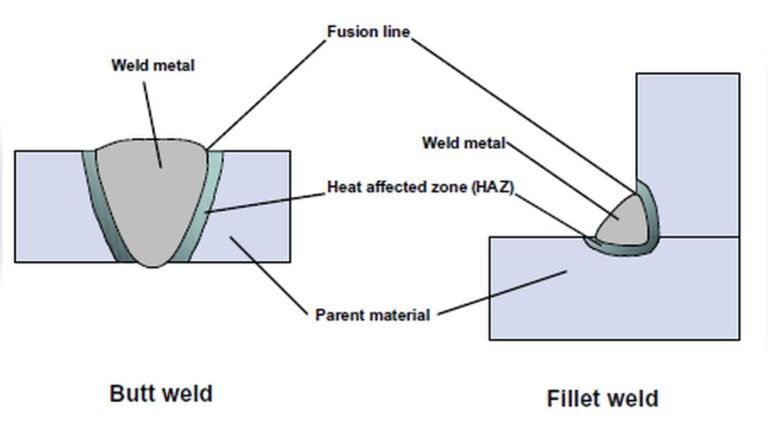
Welding joins metal pieces to make strong parts. Two common weld types are Butt Weld and Fillet Weld. Many people wonder which one is better. This guide explains both clearly and simply.
What Is a Butt Weld?
A Butt Weld joins two metal pieces placed end to end. Imagine putting two sticks in a line and gluing the ends together. That is like a butt weld. The welding happens along the joint where the edges meet.
This type of weld is strong because the metals are joined on the same flat plane. It allows the weld to go deep inside the metals. This is called full penetration. Full penetration means the weld can hold very strong forces.
Butt welds often need the metal edges to be prepared well. Sometimes, the edges are cut at an angle or beveled. This helps the welder make a stronger joint. It takes skill and time to prepare and weld a butt joint.
Types Of Butt Welds
- Square Butt Weld: Edges are straight and flat.
- V-Groove Weld: Edges are cut to form a V shape.
- Bevel-Groove Weld: One edge is beveled or angled.
- U-Groove Weld: Edges are shaped like a U.
- J-Groove Weld: One edge has a J shape.
What Is a Fillet Weld?
A Fillet Weld joins two metal pieces at a right angle. Imagine two sticks crossing like the letter “T” or “L”. The weld is placed in the corner where they meet. The shape of the weld looks like a triangle.
Fillet welds are easier and faster to make. The metal edges do not need much preparation. Welders can work on fillet welds in many positions, such as flat, vertical, or overhead.
Fillet welds are common in building frames, structures, and metal parts that hold less pressure. They offer good strength but not as much as butt welds.
Common Uses Of Fillet Welds
- Joining metal plates in a T-shape or lap joint.
- Building steel frames for buildings or machines.
- Repair work and quick fixes.
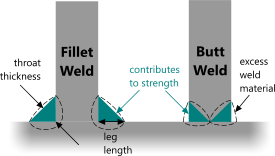
Credit: www.calqlata.com
Key Differences Between Butt Weld and Fillet Weld
| Feature | Butt Weld | Fillet Weld |
|---|---|---|
| Joint Type | Ends of two metals joined edge to edge | Two metals joined at a right angle (corner) |
| Shape | Flat, straight seam | Triangular cross-section |
| Preparation | Requires edge beveling or grinding | Little to no edge preparation needed |
| Strength | Very strong, full penetration | Moderate strength, partial penetration |
| Skill Level | Higher skill and precision needed | Easier to perform, less skill needed |
| Cost and Speed | More time and cost due to prep and filler | Faster and cheaper to apply |
| Common Uses | Pipes, pressure vessels, high-stress parts | Structural steelwork, frames, general fabrication |
Advantages of Butt Weld
- Strongest type of weld joint.
- Can handle high pressure and stress.
- Weld can be ground smooth for a clean finish.
- Full penetration improves fatigue resistance.
Disadvantages of Butt Weld
- Requires careful edge preparation.
- Needs skilled welders to do well.
- Uses more welding material (filler metal).
- Slower and more costly process.
Advantages of Fillet Weld
- Simple and fast to apply.
- Little or no edge preparation required.
- Less skill needed compared to butt welds.
- Cost-effective for many applications.
Disadvantages of Fillet Weld
- Weaker than butt welds due to partial penetration.
- Not suitable for high-pressure joints.
- May not look as smooth or clean.
When to Use Butt Weld
Use butt welds when strength is very important. For example:
- Pipes carrying gas or liquids under pressure.
- Structural parts that face heavy loads.
- Parts where fatigue resistance matters.
Butt welds make sure the joint is as strong as the metal itself.
When to Use Fillet Weld
Fillet welds work well when speed and cost matter. For example:
- Building metal frames and supports.
- Joining parts that do not hold pressure.
- Quick repairs or temporary structures.
Fillet welds are great for simple connections and where full strength is not required.
Summary
Both butt welds and fillet welds have their place in metalwork. Knowing the difference helps you choose the right weld.
Butt Welds offer strength and durability. They need skill and more time.
Fillet Welds are faster and easier. They work well for many basic joints.
Think about your project’s needs. Choose the weld type that fits best.
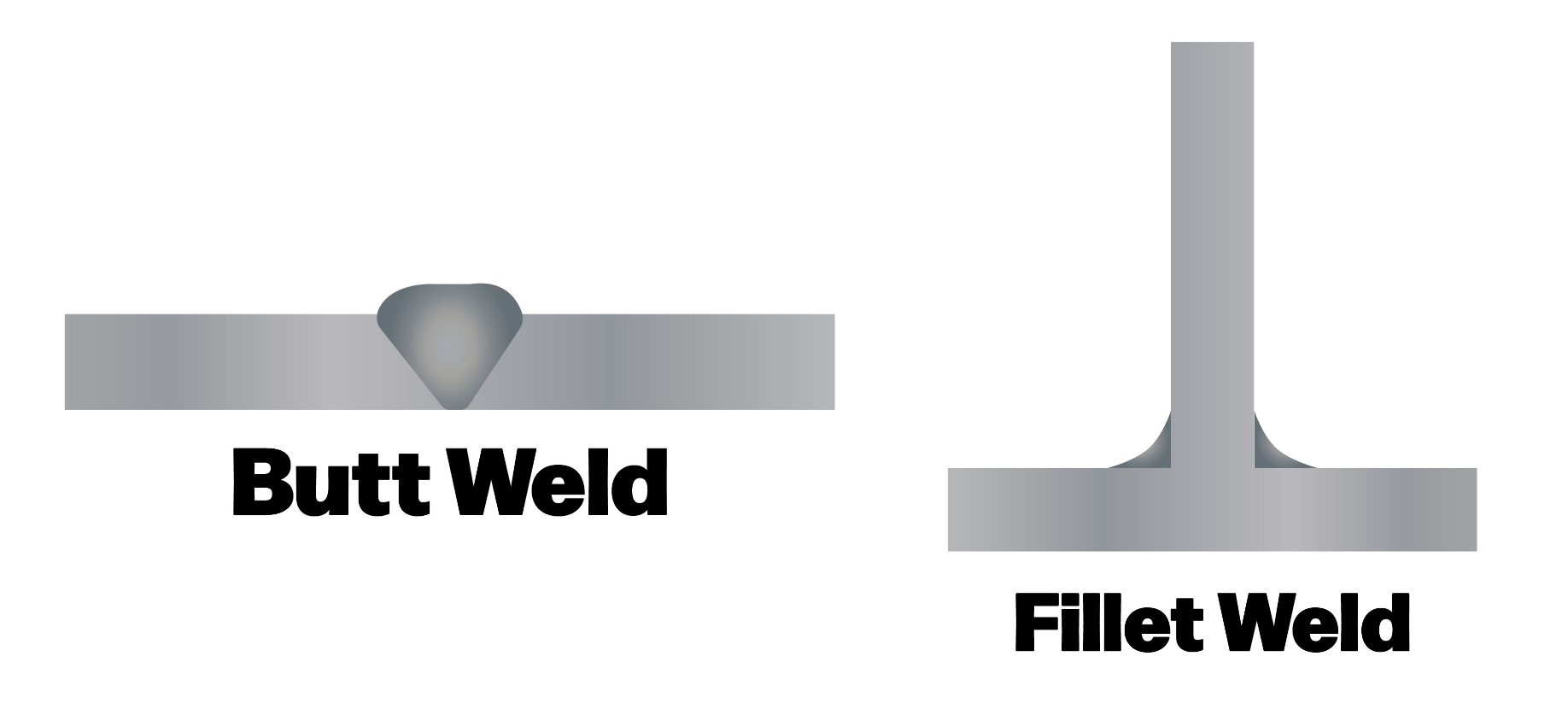
Credit: nsarc.com
Glossary
| Term | Meaning |
|---|---|
| Butt Weld | Joining two metal edges on the same flat plane. |
| Fillet Weld | Welding two metal pieces at a right angle corner. |
| Full Penetration | Weld goes through entire thickness of metal. |
| Bevel | Cutting metal edges at an angle for better weld. |
| Filler Metal | Extra metal used to fill the weld joint. |
Frequently Asked Questions
What Is A Butt Weld?
A butt weld joins two metal pieces end-to-end on the same plane. It provides full penetration and high strength, ideal for pipes and pressure vessels. This weld often requires edge preparation and skilled execution, ensuring a strong, seamless joint suitable for high-stress applications.
What Is The Strongest Weld Joint?
The strongest weld joint is the butt weld. It joins two metal pieces end-to-end with full penetration. This creates strength equal to the base metal, ideal for high-stress and pressure applications. Butt welds outperform fillet welds in durability and fatigue resistance.
What Are The 4 Types Of Fillet Welds?
The four types of fillet welds are: 1) Tee fillet weld, 2) Lap fillet weld, 3) Corner fillet weld, and 4) Edge fillet weld. Each type joins metals at different angles or positions, commonly used in structural and frame welding for strong, efficient joints.
What Is A Butt Weld In Simple Terms?
A butt weld joins two metal pieces end-to-end on the same plane. It creates a strong, continuous joint. This type is common in pipe and plate welding.