
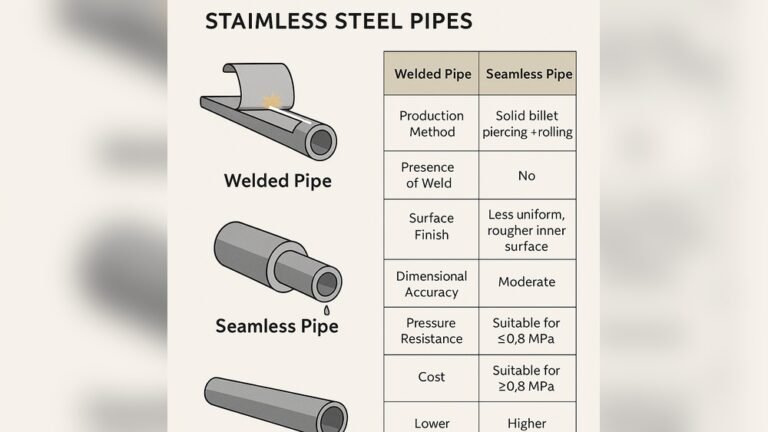
Pipes are everywhere. They carry water, gas, oil, and many other things. Two common types are seamless pipes and welded pipes. Many people wonder which one to choose. This article will explain the differences in a simple way. It will help you understand which pipe works best for different jobs.
What Are Seamless Pipes?
Seamless pipes are made without any welds or joints. They are made from a solid round metal called a billet. The billet is heated and then pushed or pulled through a die to make a hollow tube. This process makes the pipe strong and smooth inside and outside.
Key features of seamless pipes:
- No weld joints or seams
- Strong and durable
- Good for high pressure use
- Smooth inner surface
- More expensive to make
What Are Welded Pipes?
Welded pipes are made by rolling a flat steel plate or strip into a tube shape. Then, the edges are joined together by welding. Welding means melting the edges and fusing them together. There are different types of welding used, such as Electric Resistance Welding (ERW) or Submerged Arc Welding (SAW).
Key features of welded pipes:
- Have a weld seam along the pipe
- Less expensive to produce
- Available in many sizes and shapes
- Used for low to medium pressure
- May have small imperfections at weld
How Are Seamless and Welded Pipes Made?
| Process Step | Seamless Pipe | Welded Pipe |
|---|---|---|
| Starting Material | Solid metal billet | Flat steel plate or strip |
| Forming | Billet is heated and stretched to make a hollow tube | Flat steel is rolled into a cylindrical shape |
| Joining | No joining or welding | Edges are welded together to form a seam |
| Finishing | May be polished or treated for smoothness | Weld seam is tested and cleaned |
| Cost | Higher due to complex process | Lower due to simpler process |
Strength and Durability
Seamless pipes are usually stronger. Why? Because they have no weld seam. A weld seam can be a weak point. It may crack or leak under high pressure. Seamless pipes can handle very high pressure and heat. This makes them good for tough jobs like oil and gas pipelines.
Welded pipes are still strong but not as strong as seamless pipes. They work well in situations with less pressure. For example, water pipes in buildings or large tanks. Welded pipes can be made in bigger sizes too. This is useful when size matters more than pressure.

Credit: www.priminox.com
Cost Differences
Seamless pipes cost more money. The making process is harder and slower. The raw material billet is also more expensive. For small projects or low pressure needs, seamless pipes may be too costly.
Welded pipes cost less. They can be made quickly and in large amounts. This makes them good for big projects. When cost is a key factor, welded pipes are a smart choice.
Corrosion Resistance
Corrosion means rust or damage caused by chemicals or water. Seamless pipes often resist corrosion better. Their smooth inner surface does not trap dirt or chemicals. Welded pipes have a weld seam where corrosion can start. Special coatings or treatments can help protect welded pipes.

Credit: savree.com
Size and Shape Options
Welded pipes can be made in many sizes and shapes. Round, square, or rectangular pipes are possible. This is because they start from flat steel plates.
Seamless pipes are mostly round. Their size options are more limited. They are made by stretching the billet, which limits the shapes possible.
Common Uses of Seamless Pipes
- Oil and gas pipelines
- High-pressure boilers
- Chemical plants
- Power plants
- Automobile parts
Common Uses of Welded Pipes
- Water and sewage systems
- Structural purposes in buildings
- Large diameter pipes for low pressure
- Conduit for electrical wiring
- Transporting gases at low pressure
Problems That May Occur
Even the best pipes can have problems. Here are some common issues.
Seamless Pipes
- Surface scratches from handling
- Wall thickness may vary
- Internal stress can cause cracks
- Oval shape instead of round
- Corrosion in harsh environments
Welded Pipes
- Weld seams can be weak points
- Seam may crack under stress
- Imperfections around weld area
- May need extra testing for safety
- Corrosion can start at weld
Which One Is Better?
There is no single answer. It depends on what you need.
Choose seamless pipes if:
- You need high strength and pressure resistance
- The project is critical or dangerous
- Corrosion resistance is important
- You can spend more money
Choose welded pipes if:
- You want a lower cost solution
- Size variety is important
- The pressure is not very high
- The project is large scale and non-critical
Summary Table: Seamless vs Welded Pipes
| Feature | Seamless Pipe | Welded Pipe |
|---|---|---|
| Manufacturing | Made from solid billet, no weld | Made from rolled steel, welded seam |
| Strength | Higher strength, handles high pressure | Good strength, handles low to medium pressure |
| Cost | More expensive | Less expensive |
| Sizes & Shapes | Limited sizes, mostly round | Wide range, round and other shapes |
| Corrosion Resistance | Better due to no weld seam | Needs treatment, weld seam can corrode |
| Common Uses | Oil, gas, chemical, power plants | Water, construction, low pressure pipes |
Final Thoughts
Both seamless and welded pipes have their place. The choice depends on your needs, budget, and project type. Seamless pipes offer strength and safety. Welded pipes give flexibility and cost savings. Knowing these differences helps you make the right choice.
Next time you see a pipe, think about how it was made. You will understand why one pipe works better than another. This knowledge is useful for builders, engineers, and anyone working with pipes.
Frequently Asked Questions
Which Is Better, Seamless Or Welded Pipe?
Seamless pipes offer higher strength, pressure capacity, and corrosion resistance for critical uses. Welded pipes cost less and suit non-critical, large projects. Choose seamless for demanding environments; pick welded for budget-friendly, versatile size needs.
Is Seamless Or Welded Pipe More Expensive?
Seamless pipes cost more due to higher strength and manufacturing complexity. Welded pipes are cheaper and suit non-critical uses.
What Is Seamless Pipe Used For?
Seamless pipes transport fluids like water, gas, and waste. They suit high-pressure, corrosive, and structural applications in oil, gas, and chemical industries.
What Are The Common Problems With Seamless Pipe?
Common problems with seamless pipes include surface scratches, dimensional inaccuracies, internal stress, cracking, ovality, wall thickness variations, and corrosion in aggressive environments. These issues can affect performance, especially under high pressure and corrosive conditions. Proper inspection and quality control help minimize these defects.