
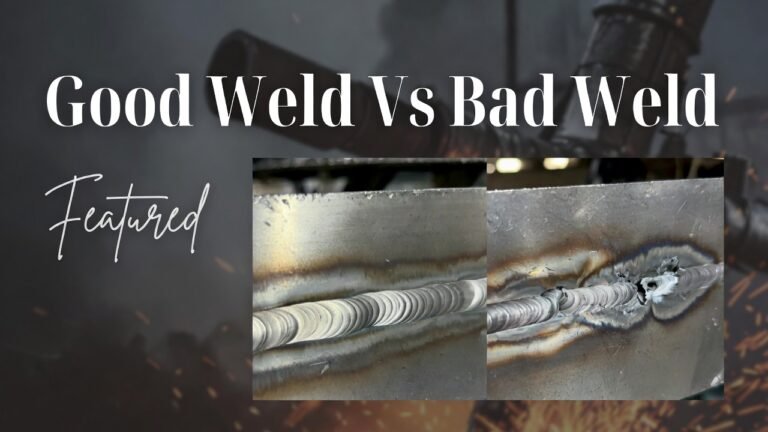
Welding joins two pieces of metal by melting them together.
Some welds are strong and last a long time. Others are weak and may break.
This article explains the difference between a good weld and a bad weld.
We will look at how to recognize each type. This helps keep things safe and strong.
Read What Happens When Welding Current is Too High
What Is a Good Weld?
A good weld joins metal parts firmly and evenly.
It looks smooth and clean. It has no cracks or holes.
The metal melts well and fuses fully with the base parts.
This makes the joint as strong as the metal itself.
Key Features Of A Good Weld
- Uniform width: The weld bead is the same size all along.
- Smooth surface: No bumps or rough spots.
- No spatter: Small drops of metal do not stick around the weld.
- Good penetration: The weld melts deep into the base metals.
- No cracks or holes: The weld is solid and complete.
- Proper shape: The weld has a nice, even curve or flat shape.
- Strong bond: It holds under pressure without breaking.
Why Does A Good Weld Matter?
A good weld keeps structures safe. It holds parts firmly together.
Good welds last a long time and resist damage.
For bridges, cars, and buildings, strong welds prevent accidents.
What Is a Bad Weld?
A bad weld is weak and unsafe.
It may look messy or uneven.
Bad welds often have cracks, holes, or rough edges.
They can break easily under stress.
Signs Of A Bad Weld
- Uneven width: The weld bead changes size and shape.
- Rough or bumpy surface: The weld is not smooth.
- Spatter around weld: Small metal drops stuck near the weld.
- Poor penetration: The weld does not melt deeply into metal.
- Cracks or holes: Visible breaks or gaps in the weld.
- Undercutting: The edges of the weld look eroded or thin.
- Weak bond: The weld can break or separate easily.
Why Do Bad Welds Happen?
Bad welds happen when the welder moves too fast or too slow.
Wrong heat or current settings cause poor melting.
Dirty metal surfaces make welds weak.
Not enough skill or care can also cause bad welds.
Visual Comparison: Good Weld Vs Bad Weld
| Feature | Good Weld | Bad Weld |
|---|---|---|
| Appearance | Smooth and even | Rough and uneven |
| Bead Width | Consistent size | Varies, often too wide or narrow |
| Spatter | None or very little | Lots of spatter around weld |
| Penetration | Deep and full | Shallow or incomplete |
| Cracks or Holes | None | Visible cracks or holes |
| Strength | Strong and durable | Weak and breaks easily |
| Edges | Clean and smooth | Undercut or eroded |
Common Welding Problems That Lead to Bad Welds
Let’s look at some mistakes that cause bad welds.
1. Too Much Heat
When the heat is too high, metal burns or melts too fast.
This makes holes or weak spots in the weld.
2. Too Little Heat
Low heat means metal does not melt well.
The weld sits on top and does not join fully.
3. Wrong Travel Speed
Moving the welding tool too fast causes weak welds.
Moving too slow makes the weld too wide and uneven.
4. Dirty Metal
Oil, rust, or paint on metal stops good fusion.
Always clean metal before welding.
5. Poor Technique
Inexperienced welders may not keep steady hands.
They may not hold the tool at the right angle.
How to Improve Weld Quality
Good welds take practice and care.
Here are some tips to help make better welds.
- Clean metal: Remove dirt and rust before welding.
- Correct settings: Use the right heat and current for the metal.
- Steady hands: Keep a steady pace and angle.
- Practice: Try welding on scrap metal first.
- Inspect welds: Check for cracks, holes, or rough spots.
- Adjust speed: Move at a steady, even pace.
Why Weld Inspection Is Important
Inspecting welds ensures safety and strength.
Bad welds can cause accidents or failures.
Experts use visual checks and tests to find problems.
Good welds pass tests and hold strong under pressure.
Summary: Good Weld Vs Bad Weld
A good weld is clean, smooth, and strong.
A bad weld is rough, uneven, and weak.
Good welds join metals fully and last a long time.
Bad welds may crack, break, or fail quickly.
Careful technique, correct settings, and clean metal help make good welds.
Always check welds before using the welded object.
Remember, a good weld keeps things safe and reliable.
Bad welds can be dangerous and costly.
Learn to spot the difference for better results.
Frequently Asked Questions
How To Tell A Good Weld From A Bad Weld?
A good weld is uniform, smooth, and consistent in thickness with no cracks or spatter. It shows proper penetration and fusion. A bad weld appears irregular, with excessive spatter, undercutting, and weak joints that may break under stress.
What Defines A Good Weld?
A good weld is uniform, smooth, and consistent in thickness. It shows no cracks, spatter, or undercutting. It has strong penetration and fuses materials securely. A quality weld withstands designed loads without breaking. Proper voltage and travel speed ensure a clean, reliable weld bead.
How Should A Proper Weld Look?
A proper weld is smooth, uniform, and consistent in thickness. It shows good penetration without cracks or spatter. The weld bead stays straight with no undercutting. It fuses materials firmly, matching their strength for lasting durability.
What Is A Bad Weld?
A bad weld has irregular shape, excessive spatter, undercut edges, and weak fusion. It lacks proper penetration and breaks under stress.